

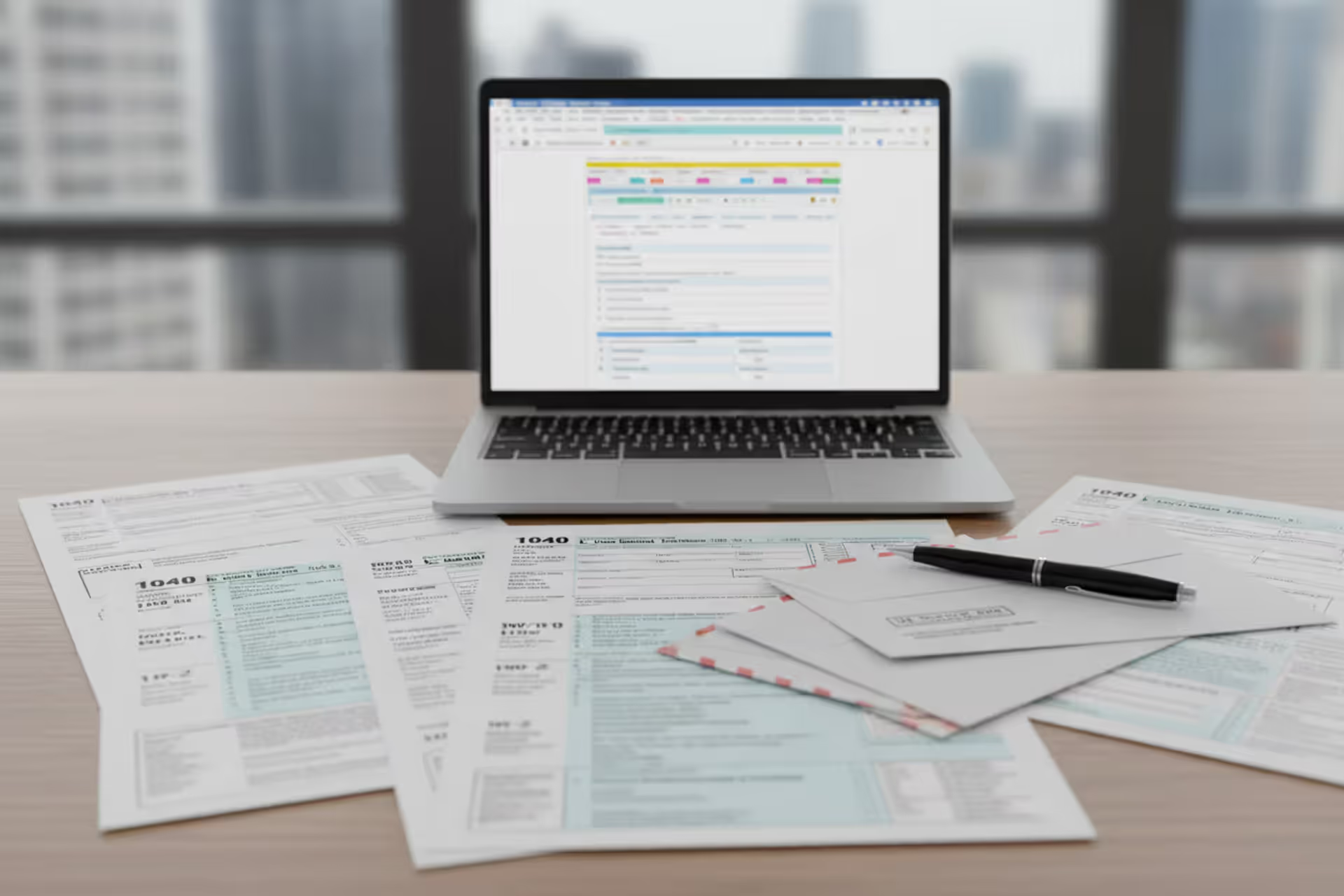
Tax filing documents, laptop, and office desk setup
How to File a Federal Tax Return

Tax season rolls around every spring, and Americans file roughly 160 million returns between January and April. Despite the collective groan that accompanies W-2 season, preparing your return doesn't have to turn into a multi-week ordeal filled with confusion and dread.
Here's how the system works: Throughout the year, your employer withholds money from each paycheck, making an educated guess about your eventual tax bill. Come spring, you tally up what you actually earned, figure out what you truly owe, and reconcile the difference. Withheld too much? The IRS cuts you a refund check. Didn't withhold enough? You'll need to pay the balance.
The whole experience becomes infinitely smoother when you nail three fundamentals: rounding up the correct paperwork before you start, selecting a filing method that matches your comfort level and tax complexity, and double-checking your work to catch mistakes before they cause problems.
Who Must File a Federal Income Tax Return

Author: Lauren Whitma;
Source: atiservicesoftampa.com
The law doesn't require everyone to file. Whether you need to submit a return depends on how much you earned, your age, how you'll file, and what type of income landed in your bank account.
Let's look at 2025 income thresholds. Single filers younger than 65 hit the requirement once gross income reaches $14,600. Turn 65 and that number bumps to $16,550. Married couples filing together face a $29,200 threshold when neither spouse has reached 65. One spouse crosses into 65-and-over territory? The requirement kicks in at $30,750. Both spouses 65 or older bring the threshold to $32,300.
Head of household status applies when you're unmarried, you paid more than half the cost of keeping up your home, and a qualifying person lived with you for over half the year. This status requires filing once you exceed $21,900 in income (under 65) or $23,850 (65 and older). Married individuals filing separately face the strictest rule: gross income of just $5 makes filing mandatory, regardless of age.
Self-employment changes everything. Pull in $400 or more net profit from freelancing, consulting, driving for rideshare services, or running any business? You're filing a return, period. The IRS insists on this because you owe self-employment taxes covering Social Security and Medicare, even when your total income looks modest.
Certain situations create filing requirements independent of income levels. Took money from a health savings account for non-medical purposes? Filed for unemployment? Owe the alternative minimum tax? Each of these scenarios means you're submitting a return. The same goes for household employment taxes, early distributions from retirement accounts that trigger penalties, or receiving advance premium tax credit payments.
Sometimes filing makes sense even when the law doesn't force you. Did your employer withhold federal taxes from your paychecks? That money represents an interest-free loan you gave the government. Filing constitutes the only way to get it back. Refundable credits like the Earned Income Tax Credit could generate payments exceeding what you paid in—but you'll never see that money without actually filing.
Documents and Information You Need Before Filing
Assembling everything upfront beats hunting for missing paperwork halfway through your return. You'll want proof of income, documentation supporting deductions or credits, and personal information for everyone mentioned in your filing.
Employers must send Form W-2 by January 31, showing wages paid and taxes withheld. Held three jobs during the year? Expect three separate W-2 forms arriving from different employers.
The 1099 form series covers additional income. Companies send Form 1099-NEC to contractors and freelancers who earned $600 or more. Financial institutions issue Form 1099-INT when your interest income tops $10. Brokerage firms provide Form 1099-DIV documenting dividend payments. State workforce agencies mail Form 1099-G showing unemployment compensation. Retirement account distributions appear on Form 1099-R.
You'll need accurate Social Security numbers for everyone: yourself, your spouse if filing jointly, and each dependent. The IRS runs these numbers against Social Security Administration databases. Mismatches bring processing to a screeching halt.
Dig out last year's completed return. You'll need information from it—specifically your adjusted gross income, which electronic filing systems use to verify your identity. Prior-year carryover deductions and bank account numbers (if you're using the same accounts) live there too.
Planning to itemize deductions rather than accepting the standard deduction? Stack up your evidence. Mortgage lenders send Form 1098 showing interest payments. Local assessors provide property tax bills. Charities must give receipts for donations—dropping off bags of clothes without documentation means you can't claim anything. Medical expenses matter too, though only amounts exceeding 7.5% of adjusted gross income become deductible.
Education credits demand Form 1098-T from colleges plus receipts proving qualified expenses like tuition and mandatory fees. Textbooks, housing, and meal plans don't qualify.
Want your refund deposited directly rather than waiting weeks for a mailed check? You'll need your bank routing number (nine digits) and account number. Both print at the bottom of checks. One incorrect digit sends your refund to someone else's account, so verify these numbers carefully.
Choosing Your Federal Return Filing Method
Multiple approaches exist for completing your federal return filing. Each carries its own strengths and limitations.

Author: Lauren Whitma;
Source: atiservicesoftampa.com
Paper Filing vs. Electronic Filing
Traditional paper filing means printing IRS forms (or requesting them by mail), filling everything out by hand, and mailing the completed package to the processing center serving your state. This approach costs virtually nothing beyond postage, works without internet access, and gives you complete control over the process.
The disadvantages create real headaches. Processing takes six to eight weeks compared to three weeks maximum for electronic submissions. Errors happen more frequently because IRS employees manually type in handwritten information. Refunds arrive slowly. You won't know whether your envelope reached its destination unless you spring for certified mail with return receipt requested.
Electronic filing transmits returns directly into IRS systems. Software catches common errors before submission occurs. Acceptance confirmation arrives within 24 hours. Refunds land substantially faster. Approximately 90% of returns now arrive electronically—it has become the standard method for legitimate reasons.
Tax Software Options
Tax software guides you through interview-style questions, automatically populates required forms, handles all calculations, and submits everything electronically. TurboTax, H&R Block, TaxAct, and FreeTaxUSA dominate this market.
Companies structure pricing in tiers. Basic packages handle straightforward W-2 situations with standard deductions, generally costing $30-$60 for federal filing. Mid-tier products accommodate itemized deductions, rental properties, and investment sales for $60-$90. Premium versions tackle business income, farm income, and foreign tax situations, often running $90-$120 or higher.
Software excels at preventing arithmetic mistakes and highlighting commonly missed deductions. The question-and-answer format helps when official IRS instructions make your brain hurt. Just remember one thing: you stay responsible for entering correct information and understanding whether the software's recommendations actually apply to your specific circumstances.
Hiring a Tax Professional
Certified Public Accountants, Enrolled Agents, and tax attorneys bring specialized knowledge to complex situations. They track changes in tax legislation, represent you during audits, and provide strategic advice for legally minimizing your tax burden.
Fees swing wildly based on complexity and location. A straightforward W-2 return might cost $150-$300. Add itemized deductions, self-employment income, or rental properties and you're looking at $300-$600. Complicated scenarios involving business ownership, returns in multiple states, or foreign financial accounts can exceed $1,000.
Tax professionals earn their fees when your financial life gets complicated: operating a business, substantial investment activity, rental property ownership, foreign income or accounts, or major life changes like divorce, inheritance, or business formation. They're also worthwhile if you'd simply rather delegate the entire task to someone else.
IRS Free File Program
The IRS collaborates with tax software companies to offer free federal preparation and electronic filing for qualifying taxpayers. For 2025 returns, adjusted gross income must fall below $79,000 to participate.
Each participating company sets its own additional eligibility rules beyond income—age limits, state residency requirements, or restrictions on which forms you can include. Visit the IRS Free File website, compare available options, and pick software that accommodates your specific circumstances.
Free File delivers identical functionality to paid versions for eligible users: electronic filing, direct deposit capability, error checking. The catch? State returns often cost extra, and companies aggressively market upgrades to paid products.
Income above $79,000? Free File Fillable Forms offer electronic versions of official IRS forms. You'll need to understand which forms your situation demands and how to accurately complete them, but filing remains free regardless of income level.
Step-by-Step Federal Tax Filing Process
Filing follows a predictable sequence. Move through these stages methodically to minimize errors and avoid overlooking valuable deductions or credits.
Step 1: Establish your filing status. Pick from single, married filing jointly, married filing separately, head of household, or qualifying surviving spouse. This choice affects your standard deduction amount, income brackets for tax rates, and eligibility for various credits. Head of household demands unmarried status, covering more than half the household expenses, and housing a qualifying dependent for over six months.
Step 2: Total all income. Add up wages from W-2s, self-employment profits, interest earnings, dividend payments, capital gains, retirement distributions, unemployment benefits, and other taxable income. This sum represents gross income.
Step 3: Calculate adjusted gross income. Subtract allowed "above-the-line" adjustments from gross income. These include traditional IRA contributions, student loan interest paid (maximum $2,500), half of self-employment tax, health savings account contributions, and self-employed health insurance premiums. The remainder becomes your AGI, which determines eligibility for numerous credits and deductions.
Step 4: Decide between standard deduction and itemizing. In 2025, standard deductions equal $14,600 (single), $29,200 (married filing jointly), and $21,900 (head of household). Itemizing benefits you only when allowable expenses—mortgage interest, state and local taxes capped at $10,000 combined, charitable contributions, medical expenses above 7.5% of AGI—surpass your standard deduction.
Step 5: Subtract your chosen deduction from AGI. What remains represents taxable income—the amount subjected to graduated tax rates.
Step 6: Apply appropriate tax rates. Reference tax tables or the tax computation worksheet in Form 1040 instructions. For 2025, federal income tax rates span from 10% to 37% depending on income level and filing status.
Step 7: Claim eligible tax credits. Credits reduce your tax bill dollar-for-dollar, making them more powerful than deductions. Common examples: Child Tax Credit ($2,000 per qualifying child), Earned Income Tax Credit (varies by income and family composition), education credits (American Opportunity Credit worth up to $2,500 or Lifetime Learning Credit worth up to $2,000), and Child and Dependent Care Credit.
Step 8: Determine your refund or balance due. Compare total tax (after credits) against federal taxes withheld from paychecks plus any estimated tax payments submitted during the year. Withholding exceeds tax? You'll get a refund. Tax exceeds withholding? You owe the difference.
Step 9: Complete Form 1040 and necessary schedules. Form 1040 serves as the main federal tax form. Attach schedules reporting specific items: Schedule 1 (additional income and adjustments), Schedule 2 (additional taxes), Schedule 3 (additional credits), Schedule A (itemized deductions), Schedule B (interest and dividends above thresholds), Schedule C (business profit or loss), Schedule D (capital gains and losses), and Schedule E (rental and royalty income).

Author: Lauren Whitma;
Source: atiservicesoftampa.com
Step 10: Review everything meticulously. Confirm names and Social Security numbers match official documents exactly. Verify calculations. Triple-check bank routing and account numbers for direct deposit. Confirm signatures appear—joint returns require both spouses to sign.
Step 11: Submit your return. Choose electronic filing whenever possible for faster processing and immediate confirmation. Mailing a paper return? Send it to the correct IRS address for your state and whether you're including payment. Consider certified mail for proof of delivery.
Federal Tax Return Deadlines and Extensions
April 15 serves as the standard annual deadline. Whenever April 15 falls on a weekend or federal holiday, the due date moves to the next business day. For 2025 tax returns, the deadline lands on April 15, 2026.
Running behind schedule? Request an automatic extension using Form 4868. Submit it electronically through tax software or the IRS website, or mail a paper version. Extensions provide extra time until October 15 to finish your return.
Here's the critical distinction: extensions grant additional time to complete your return, not additional time to pay what you owe. Estimate your tax liability and submit payment by the April deadline to avoid interest charges and penalties. Underestimate significantly and you'll accrue interest from April 15 forward, plus potential penalties.
Late-filing penalties hurt. The IRS charges 5% of unpaid taxes for each month (or part of a month) your return arrives late, maxing out at 25% of what you owe. File over 60 days late and you'll face a minimum penalty: either $485 or 100% of the tax you owe, whichever amount is smaller.
Late-payment penalties accumulate more gradually but still inflict damage. Expect 0.5% of unpaid taxes each month, also capped at 25%. Interest compounds daily on both unpaid taxes and penalties at the federal short-term rate plus three percentage points.
State deadlines typically mirror the federal deadline, though exceptions exist. Several states establish different due dates or handle extensions differently. Federal and state returns go to separate agencies and must be filed independently.
Common Mistakes to Avoid When Filing Your Federal Return
Small errors create outsized headaches. The IRS processes returns more slowly when corrections or additional documentation become necessary.
Arithmetic errors lead the pack. Software handles calculations, but data entry mistakes still cause havoc. Transpose two numbers, misplace a decimal point, or add incorrectly on paper forms and you'll create discrepancies between what you reported and what IRS systems calculate.
Social Security numbers that don't match or names differing from Social Security Administration records trigger immediate rejections for electronic returns and processing delays for paper ones. Using nicknames instead of legal names, misspelling names, or neglecting to update your name with Social Security after marriage or divorce creates matching problems.
Unsigned returns get treated as invalid. Joint returns demand both spouses' signatures. Electronic signatures work through software, but paper returns require actual pen-to-paper signatures.
Incorrect bank information for direct deposit forces the IRS to issue paper checks instead, postponing refunds by several weeks. Copy routing and account numbers directly from checks or bank statements rather than relying on memory.
Filing status errors happen when people misunderstand eligibility rules. You can't choose head of household simply because you're unmarried—you must also financially support a qualifying dependent and pay most household expenses. Married taxpayers must select married filing jointly or married filing separately; choosing single status isn't permitted.
Omitting income creates issues when the IRS receives copies of your W-2s and 1099s. Their matching algorithms compare these documents against your return, and discrepancies generate automated notices.
Claiming ineligible dependents invites trouble. Children must satisfy age, relationship, residency, and support tests. You can't claim your 25-year-old child who lives separately and supports themselves financially, even if you occasionally helped with bills.
Missing required forms leaves returns incomplete. Skip Schedule C when you have self-employment income? Your return's not done. Claim education credits without attaching Form 8863? The IRS will request it, slowing down processing.
After You File: What to Expect
The single biggest factor separating smooth tax filing from chaotic scrambling is record-keeping throughout the year. When tax season arrives, you'll have everything you need to file accurately and claim every deduction and credit you're entitled to. That preparation transforms the entire process from stressful to straightforward
— Jennifer Martinez
After submitting your return, several processes unfold behind the scenes.
Electronic returns generate acknowledgment within 24 hours confirming the IRS received and accepted your return. This doesn't mean complete processing or refund approval—simply that it passed initial screening and entered the processing queue.
Paper returns don't generate acknowledgments. You won't know the IRS received yours unless you paid for certified mail with return receipt requested, or until activity shows up using the "Where's My Refund?" tool on the IRS website.
Refund timelines depend on filing method and payment delivery method. Electronic returns with direct deposit typically deliver refunds within three weeks. Paper returns extend this timeline to six or eight weeks. Paper check refunds add approximately another week.
The IRS "Where's My Refund?" tool updates information once daily, usually overnight. Check refund status 24 hours after e-filing acceptance or four weeks after mailing paper returns. You'll need your Social Security number, filing status, and the exact refund amount from your return.
Some returns undergo heightened scrutiny. The IRS may verify income figures, credits, or deductions you claimed. Returns claiming Earned Income Tax Credit or Additional Child Tax Credit face enhanced review and generally take longer to process. You might receive a letter requesting documentation supporting specific claims.

Author: Lauren Whitma;
Source: atiservicesoftampa.com
Audits affect fewer than 1% of returns annually, but they happen. Selection triggers a letter explaining what the IRS wants to examine. Respond promptly with requested documentation. Most audits occur entirely through mail correspondence without in-person meetings.
Preserve return copies and supporting documents for at least three years from when you filed or the due date, whichever came later. The IRS can examine returns from the previous three years in typical situations, extending to six years when substantial income underreporting is suspected. Keep records permanently for returns where you failed to report required income, filed fraudulently, or never filed at all.
Discovered an error after filing? Submit an amended return using Form 1040-X. You have three years from the original deadline or two years from when you paid the tax (whichever is later) to claim refunds. Amended returns take considerably longer to process than original returns—typically 16 weeks or more.
Comparison of Federal Return Filing Methods
| Filing Method | Cost | Processing Timeline | Accuracy Support | Refund Speed | Best Suited For |
| Paper Forms | Postage only | 6-8 weeks | None—manual calculations required | 6-8 weeks (check arrives by mail) | Straightforward situations, limited internet access, preference for physical documentation |
| E-file (Free File) | Free for AGI under $79,000 | 3 weeks maximum | Built-in error detection, guided interview process | 2-3 weeks (direct deposit) | Income below threshold, comfortable with computers |
| Tax Software | $30-$120+ depending on complexity | 3 weeks maximum | Error detection, step-by-step guidance, deduction identification | 2-3 weeks (direct deposit) | Moderately complex situations, DIY preference, want software assistance |
| Tax Professional | $150-$1,000+ varying by complexity | 3 weeks maximum when e-filed | Expert review, strategic tax planning, audit representation | 2-3 weeks (direct deposit) | Complicated financial situations, business ownership, preference for expert handling |
Frequently Asked Questions
Federal tax returns become manageable when you understand the requirements, collect necessary paperwork, select an appropriate filing approach, and systematically work through the process. Whether you handle everything yourself using software, take advantage of Free File, or hire a professional, accuracy and meeting deadlines matter most.
Starting early beats rushing as April 15 approaches. Early filing provides cushion to track down missing documents, correct mistakes, and address unexpected complications. It also accelerates refund delivery when the government owes you money.
The IRS provides detailed instructions, and tax software includes built-in guidance walking you through each component. When things get complicated—business income, investment transactions, rental properties, or major life changes—professional help often pays for itself through prevented errors and optimized tax strategies.
Keep organized records throughout the year instead of panicking every April. A designated folder for tax documents, preserved receipts for deductible expenses, and mileage logs for business driving make preparation dramatically easier when filing season arrives. Your future self will thank you for the organization.
Related Stories

Read more
Read more




The content on this website is provided for general informational and educational purposes only. It is intended to explain concepts related to tax filing, tax software, IRS forms, deadlines, and general tax preparation processes.
All information on this website, including articles, guides, and examples, is presented for general educational purposes. Tax filing requirements may vary depending on individual circumstances, income sources, residency status, and applicable laws.
This website does not provide tax, legal, or financial advice, and the information presented should not be used as a substitute for consultation with a qualified tax professional or advisor.
The website and its authors are not responsible for any errors or omissions, or for any outcomes resulting from decisions made based on the information provided on this website.