

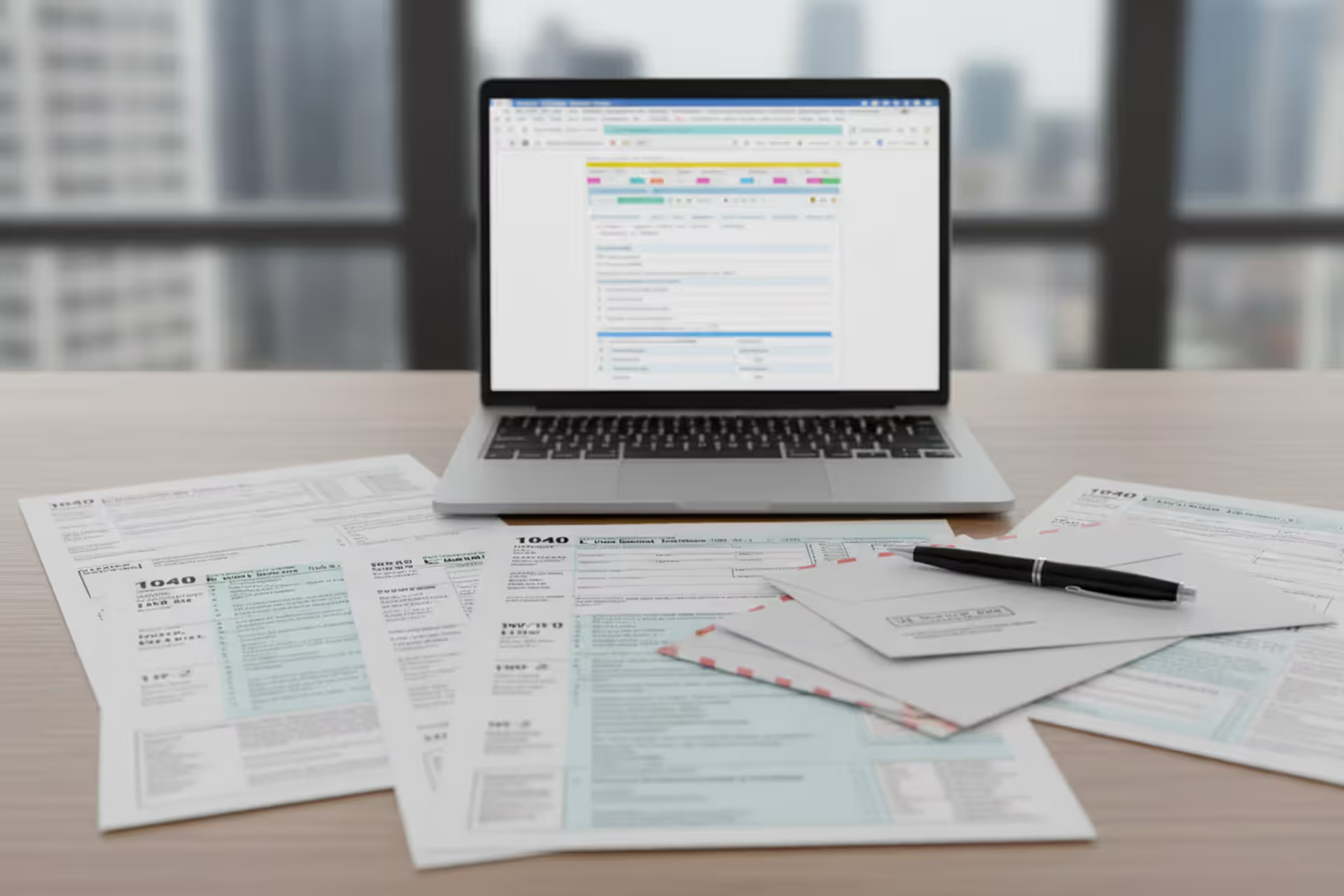
Freelancer reviewing a 1099 form and tax documents at a desk
How to File Taxes with a 1099 for Self-Employment Income

That first 1099 showing up in January hits different than a W-2 ever did. You're staring at a form listing raw income—no taxes withheld, no Social Security pulled out, nothing sent to the IRS on your behalf. Just numbers showing what people paid you, and now you're holding the bag for everything.
Traditional employees never think about taxes until April because their employer handles the math every paycheck. Contractors get the opposite experience. You track earnings across multiple clients, subtract qualifying expenses, compute what you owe for Social Security and Medicare, then mail checks to the government four separate times during the year. Mess up any piece of that sequence and you're looking at penalties that compound monthly.
But here's the thing—roughly 16 million Americans work as independent contractors right now, and most handle their taxes without drama once they understand the mechanics. The process follows clear rules. Your 1099 forms tell you what to report. Schedule C captures your profit. Schedule SE figures self-employment tax. Form 1040 ties everything together.
The key difference between people who dread tax season and people who handle it smoothly? Record-keeping habits. Save receipts and track mileage throughout the year, and filing becomes straightforward. Wait until March to reconstruct twelve months of business spending, and you'll overpay while wasting days hunting for documentation.

Author: Lauren Whitma;
Source: atiservicesoftampa.com
What follows covers the complete process: understanding different 1099 types, determining whether filing requirements apply to your situation, identifying which tax forms you'll complete, calculating what you owe, and avoiding the expensive mistakes that trip up first-timers.
What Is a 1099 Form and When Do You Receive One
1099 forms serve as income reports for people working outside traditional employment. While W-2s show wages paid to employees, 1099s document payments to contractors, freelancers, and independent service providers—people who receive money without automatic tax withholding.
The IRS maintains several 1099 variants for different payment categories. Form 1099-NEC became the standard for reporting nonemployee compensation starting in 2020. Wrote articles, designed logos, consulted on projects, or provided professional services to a business? That company sends you a 1099-NEC when your total compensation hits $600 or more during the calendar year. Previously, this type of payment appeared in Box 7 on the 1099-MISC until the IRS brought back the NEC designation.
Form 1099-MISC survived the changes but now handles different income streams. You'll receive this variant for rental payments on property or equipment you own, royalties from creative work, awards and prizes, certain healthcare payments, and fishing boat proceeds. Most categories follow the $600 reporting threshold, though specific rules vary by box number.
Form 1099-K tracks transactions processed through payment settlement entities—the Venmos, PayPals, Squares, and Stripes of the world. The reporting threshold keeps shrinking aggressively. For 2026, third-party payment processors must report when your account receives $600 total across all transactions. That's a dramatic drop from the old requirements of $20,000 and 200 separate transactions, catching millions of casual sellers by surprise.
Each form type connects to different sections of your tax return:
| Form Type | Income Category | Reporting Threshold | Required Tax Forms |
| 1099-NEC | Contract work, freelance services, consulting fees | Payments reaching $600 annually | Schedule C for business profit, Schedule SE for self-employment tax, Form 1040 as main return |
| 1099-MISC | Property rentals, royalties, awards, miscellaneous payments | Typically $600 (varies by payment type) | Schedule C or Schedule E depending on whether income qualifies as business activity |
| 1099-K | Payment card and app transactions for business | Transaction totals hitting $600 | Schedule C combining all business receipts |
Businesses must mail these forms by January 31 each year. One critical point confuses people constantly—just because you didn't receive a 1099 doesn't mean you skip reporting that income. A client paying you $450 faces no obligation to issue paperwork, but you still owe taxes on that $450 and must include it on your return.
Do You Need to File Taxes If You Received a 1099
Getting 1099 forms in the mail doesn't automatically trigger filing requirements. Your total net earnings determine whether you're obligated to file.
The magic number for self-employed individuals: $400 in net profit. Notice that's net, not gross. Take your total 1099 income, subtract legitimate business expenses, and if the remainder hits $400 or more, you're required to file a tax return. That threshold sits far below standard filing requirements for most taxpayers.
Why such a low bar? Self-employment tax operates separately from income tax. You're funding Social Security and Medicare—the same programs W-2 workers pay into automatically through FICA withholding. The difference? You cover both sides of the equation. Employees pay 7.65% while employers match that 7.65%. Self-employed individuals pay the full 15.3% themselves. Break that down: Social Security takes 12.4% on earnings up to $168,600 in 2026, while Medicare claims 2.9% on all earnings with no ceiling.
Consider a single taxpayer under age 65. Standard filing thresholds for 2026 sit around $14,600. But earn $500 from side gigs after expenses? You're filing specifically to settle self-employment tax on that $500 profit.
Certain situations require filing even below the $400 threshold. Mix W-2 wages with self-employment income and your combined totals might cross standard thresholds. Other scenarios forcing returns include:
- Owing alternative minimum tax, household employment taxes, or recapture of tax credits
- Taking distributions from HSAs, Archer MSAs, Coverdell ESAs, or 529 plans
- Filing separately while your spouse itemizes deductions
- Earning at least $108.28 from a church exempt from employer Social Security taxes
One scenario catches people off guard repeatedly: operating at a loss doesn't eliminate filing obligations. Brought in $5,000 from clients but spent $6,000 on expenses? You're showing a $1,000 loss. If you exceeded $400 in gross receipts before subtracting expenses, filing requirements still apply. That loss might benefit you though—you can offset W-2 income or other earnings, potentially generating a refund if you had withholding from another job.
Forms and Schedules Required for 1099 Income
Filing taxes on self-employment income means working through multiple interconnected forms. Each document feeds information into the next, ultimately flowing into your primary Form 1040 return.
Schedule C (Profit or Loss from Business) serves as your business tax return nested inside your personal return. You'll record every dollar clients paid, list business expenses across approximately 30 categories (from advertising to utilities), and calculate your net profit or loss. That bottom-line number transfers to two places: Line 3 on your Form 1040 and the top of your Schedule SE.

Author: Lauren Whitma;
Source: atiservicesoftampa.com
Operating a simple business without inventory, employees, depreciation claims, or home office deductions? You might qualify for Schedule C-EZ instead—a streamlined half-page version. Most contractors eventually outgrow this simplified form as their businesses develop complexity.
Schedule SE (Self-Employment Tax) computes your Social Security and Medicare obligations. The form starts with your Schedule C profit, multiplies by 92.35% (accounting for the employer-equivalent portion that W-2 workers never see), then applies the 15.3% combined rate. The calculations walk through each step, incorporating the Social Security earnings cap. Here's your consolation prize: you deduct half this self-employment tax amount as an above-the-line adjustment, reducing your adjusted gross income.
Form 1040 represents your complete tax return where all pieces converge. Schedule C profit appears on Line 3 as business income. Your self-employment tax deduction shows up on Schedule 1 attached to your 1040. After arriving at adjusted gross income, you'll either take the standard deduction or itemize, then calculate your actual tax liability using current rate tables.
Made quarterly estimated payments throughout the year? Those appear on Form 1040 as credits subtracted from your tax bill. Overpaid? You'll receive a refund. Underpaid? You'll owe the difference when filing.
Your situation might demand additional forms. Contributed to a SEP-IRA or solo 401(k)? Those need proper documentation. Claiming home office expenses requires Form 8829 unless you choose the simplified calculation method. Deducting actual vehicle costs rather than standard mileage? You'll need Form 4562 for depreciation calculations on your car.
Step-by-Step Process to Report 1099 Income on Your Tax Return
Collect every 1099 form and payment record from the tax year before starting anything else. Don't rely solely on mail delivery—download bank statements, check PayPal and Venmo histories, review all invoices sent to clients. The IRS receives copies of every 1099 form issued with your Social Security number. Their matching systems will flag discrepancies between what they received and what you report.
Step 1: Total your income from every source. Every 1099-NEC amount, every 1099-MISC payment, every 1099-K total. Watch for double-counting traps here—payment processors report gross transaction volumes that might overlap with direct 1099-NEC payments from those identical clients. Did a client pay you $3,000 through Venmo and separately send a 1099-NEC for those same $3,000? That's one payment reported twice.
Step 2: Sort business expenses into categories. Block off a few hours to review your complete financial history. What went toward software subscriptions? Office supplies? Website hosting? Client meeting meals? Equipment purchases? Liability insurance? Professional development courses? Dig up receipts for anything exceeding $75—IRS regulations require documentation at that threshold.
Step 3: Complete Schedule C section by section. Enter business identification details at the top. Record gross receipts on the first line. Sold physical products? Work through Part II calculating cost of goods sold. Part III lists expenses—separate lines for advertising (Line 8), vehicle costs (Line 9), commissions and fees (Line 10), contract labor (Line 11), office supplies (Line 18), and over twenty other categories.
Step 4: Determine net profit or loss. Schedule C performs this calculation automatically: total receipts minus total expenses. This final number drives your self-employment tax calculation. When expenses exceed income, you're reporting a loss that might reduce other taxable income on your return.
Step 5: Move your Schedule C result to Schedule SE. Most filers use Section A, the long-form version. Take net earnings, multiply by 92.35%, then calculate 15.3% of that reduced amount. The form provides line-by-line instructions and incorporates the Social Security wage ceiling automatically.
Calculating Your Self-Employment Tax
This tax blindsides first-year contractors without fail. It exists completely independent of regular income tax. Someone paying 12% on ordinary income faces an additional 15.3% hit on business profits (up to the Social Security cap).
Begin with Schedule C profit. Multiply by 92.35%—this reduction mirrors the employer's share that regular employees never notice deducted. The result becomes your tax base. Apply 15.3% to amounts falling within the Social Security ceiling ($168,600 for 2026). Apply just 2.9% to earnings beyond that cap.
High-income earners encounter an extra 0.9% Medicare surtax once earnings cross $200,000 for single filers or $250,000 for married couples filing jointly. That pushes the Medicare component to 3.8% on amounts exceeding those income levels.
Real-world example: Your freelancing netted $60,000 profit. Multiply $60,000 by 0.9235 to reach $55,410. Apply 15.3% for self-employment tax of $8,477.73. Deduct half ($4,238.87) from income, dropping your adjusted gross income to $55,761.13 before applying the standard deduction.
Claiming Deductions and Business Expenses
Every dollar spent legitimately on business operations reduces taxable profit dollar-for-dollar. Document everything—it's literally money returned to your pocket. IRS rules permit deducting "ordinary and necessary" expenses, meaning typical costs within your industry that genuinely support business operations.
Vehicle expenses represent massive deductions for contractors who travel. Choose between actual costs (fuel, maintenance, insurance, loan interest, depreciation) proportional to business usage, or the standard mileage rate (70 cents per mile for 2026). Document every business trip: date, client visited, business purpose, odometer readings. Most independents find standard mileage simpler and more beneficial unless driving a luxury vehicle.

Author: Lauren Whitma;
Source: atiservicesoftampa.com
Home office deductions apply when using part of your residence exclusively and regularly for business. Calculate the percentage of your home dedicated to business space (typically by measuring square footage), then deduct that percentage of mortgage interest or rent, utilities, homeowners insurance, and repairs. Alternative: simplified method at $5 per square foot for business areas, capped at 300 square feet ($1,500 maximum deduction). No detailed expense allocation needed.
Health insurance premiums qualify for complete deduction when self-employed, showing net profit, and lacking access to coverage through a spouse's employer. This deduction appears on Schedule 1 rather than Schedule C, yet ranks among the most valuable tax breaks for contractors.
Retirement contributions to SEP-IRAs, SIMPLE IRAs, or solo 401(k) plans slash current tax bills while funding future security. SEP-IRAs accept contributions up to 25% of net self-employment earnings, maxing out at $69,000 for 2026. Solo 401(k) plans accept $23,000 in employee deferrals plus additional employer contributions.
Smaller expenses accumulate quickly: professional licensing and association dues, business liability insurance, bank service charges, software subscriptions, continuing education improving current business skills, advertising and promotional costs, office supplies, and payments to subcontractors or professionals like bookkeepers and attorneys.
Common Mistakes When Filing Taxes with 1099 Income
First-time contractors stumble over the same issues annually. These aren't obscure tax code violations—they're straightforward oversights that trigger penalties and forfeit legitimate deductions.
Ignoring quarterly estimated payments creates more problems than any other mistake. W-2 employees have withholding handled automatically each paycheck. Contractors must proactively send money four times yearly. Expect to owe $1,000 or more after subtracting withholding and credits? Quarterly payments become mandatory. Skip them and you'll pay underpayment penalties even after sending the full amount owed by the April deadline. Penalties accrue from each quarterly due date forward, not from your annual filing date.
Mixing personal and business finances transforms expense tracking into an archaeological dig through bank statements. Running client payments through your personal checking while buying business supplies from that same account? You'll lose track of deductible expenses and struggle proving business versus personal spending during audits. Open a dedicated business account and funnel all business transactions through it exclusively.
Treating business income like hobby income happens when contractors report earnings on Schedule 1 as miscellaneous income instead of Schedule C. Hobby income offers zero expense deductions after 2018 tax law changes eliminated miscellaneous itemized deductions. The IRS presumes something qualifies as a hobby rather than business when failing to profit in three of five consecutive years, so maintain records demonstrating profit motive.
Forgetting state tax obligations catches people who relocated mid-year or served clients across multiple states. You might owe taxes to your resident state plus any state where you physically performed work or earned substantial income. Some states maintain reciprocal agreements waiving double-filing requirements, but most don't. Research rules for every state where you conducted business operations.
Claiming oversized deductions draws IRS scrutiny. Tax authorities track typical expense-to-income ratios across different industries. When your deductions appear suspiciously high relative to your income or industry benchmarks, expect questions. Maintain receipts, mileage documentation, and supporting records for everything. "I'm pretty sure I spent that" carries zero weight during audits without tangible proof.
Omitting income represents the fastest route to IRS correspondence. They receive copies of every 1099 issued bearing your Social Security number before you file your return. Automated matching systems flag discrepancies between 1099 totals and reported income. Report $40,000 when IRS records show $47,000 in 1099 forms? You're receiving a notice—potentially followed by a comprehensive audit.
New 1099 contractors neglect expense tracking during the year. They reach tax season attempting to reconstruct twelve months of spending from bank statements alone, missing substantial deductions along the way. Establish a basic tracking system in January—even a simple spreadsheet or phone app—and update weekly. This single habit preserves thousands in tax savings while eliminating hours of frustration later
— Jennifer Martinez
Quarterly Estimated Tax Payments for 1099 Workers
Self-employment operates on pay-as-you-earn principles. You don't settle your entire tax bill once in April—you prepay throughout the year in quarterly installments based on projected annual earnings. This obligation applies when expecting to owe $1,000 or more after accounting for withholding and credits.
Compute estimated payments using Form 1040-ES, which includes worksheets for projecting annual income, deductions, and credits. Estimate net self-employment profit, calculate the self-employment tax component, then estimate income tax using current tax brackets. Split your projected total tax obligation into four equal payments.
Alternative approach: pay 100% of prior year's total tax liability (110% when last year's adjusted gross income exceeded $150,000). This "safe harbor" shields you from underpayment penalties regardless of current year income increases. You'll settle any shortfall when filing your annual return. Income dropping? Reduce later quarterly payments to avoid substantial overpayments.
Quarterly deadlines don't align with calendar quarters. The IRS divides the tax year into four periods with these due dates:
- April 15 (covering January through March earnings)
- June 15 (covering April and May earnings)
- September 15 (covering June through August earnings)
- January 15 of the following year (covering September through December earnings)
Deadlines falling on weekends or federal holidays shift to the next business day. Miss a deadline and you'll owe underpayment penalties calculated from the due date until you either pay or file your annual return, whichever occurs first.
Payment methods include IRS Direct Pay through their website, Electronic Federal Tax Payment System (EFTPS), or credit card via approved payment processors (which charge convenience fees around 2%). Some contractors still mail checks with paper Form 1040-ES vouchers, but electronic payments provide immediate confirmation.
Adjust quarterly payments when income fluctuates significantly mid-year. Landed a major contract in August? Increase your September and January installments. Lost your biggest client? Lower remaining payments to prevent excessive overpayment. The IRS doesn't mandate equal quarterly amounts—you can annualize income to match payments with actual earning periods, though calculations become substantially more complex.
Many self-employed professionals automatically transfer 25-30% of every client payment into a separate savings account earmarked exclusively for taxes. Money's available when quarterly deadlines arrive, eliminating the panic of owing thousands with no funds available.
Author: Lauren Whitma;
Source: atiservicesoftampa.com
Frequently Asked Questions About Filing 1099 Taxes
Managing taxes with 1099 income demands more active involvement than W-2 employment, but the process becomes manageable once you grasp fundamental requirements. The core tasks—capturing all income accurately, organizing expenses continuously throughout the year, computing self-employment tax properly, and making quarterly payments on schedule—keep you penalty-free while minimizing your overall tax burden.
Establish solid habits during your first self-employment year: maintain separate business and personal bank accounts, automatically save a percentage of every client payment specifically for taxes, maintain organized records of expenses and mileage contemporaneously, and mark quarterly tax deadlines prominently on your calendar. These practices eliminate the panic and financial surprises that ambush unprepared contractors annually.
Tax law actually provides advantages to self-employed workers through deductions completely unavailable to traditional W-2 employees. Home office costs, vehicle expenses, retirement contributions, and health insurance premiums all reduce taxable income when properly documented and claimed on appropriate forms. Maximizing these benefits requires organizational discipline upfront, but the tax savings justify the effort invested.
When your first year managing 1099 income feels overwhelming, consider hiring a qualified tax professional to establish proper systems and verify you're capturing legitimate deductions while maintaining compliance. After understanding the complete process firsthand with professional guidance, you can decide whether continuing professional assistance makes sense or whether handling everything yourself with quality tax software meets your needs adequately. Either approach works—what matters most is investing in proper tax management through lower obligations and confidence you've fulfilled your tax responsibilities correctly and completely.
Related Stories

Read more
Read more




The content on this website is provided for general informational and educational purposes only. It is intended to explain concepts related to tax filing, tax software, IRS forms, deadlines, and general tax preparation processes.
All information on this website, including articles, guides, and examples, is presented for general educational purposes. Tax filing requirements may vary depending on individual circumstances, income sources, residency status, and applicable laws.
This website does not provide tax, legal, or financial advice, and the information presented should not be used as a substitute for consultation with a qualified tax professional or advisor.
The website and its authors are not responsible for any errors or omissions, or for any outcomes resulting from decisions made based on the information provided on this website.