

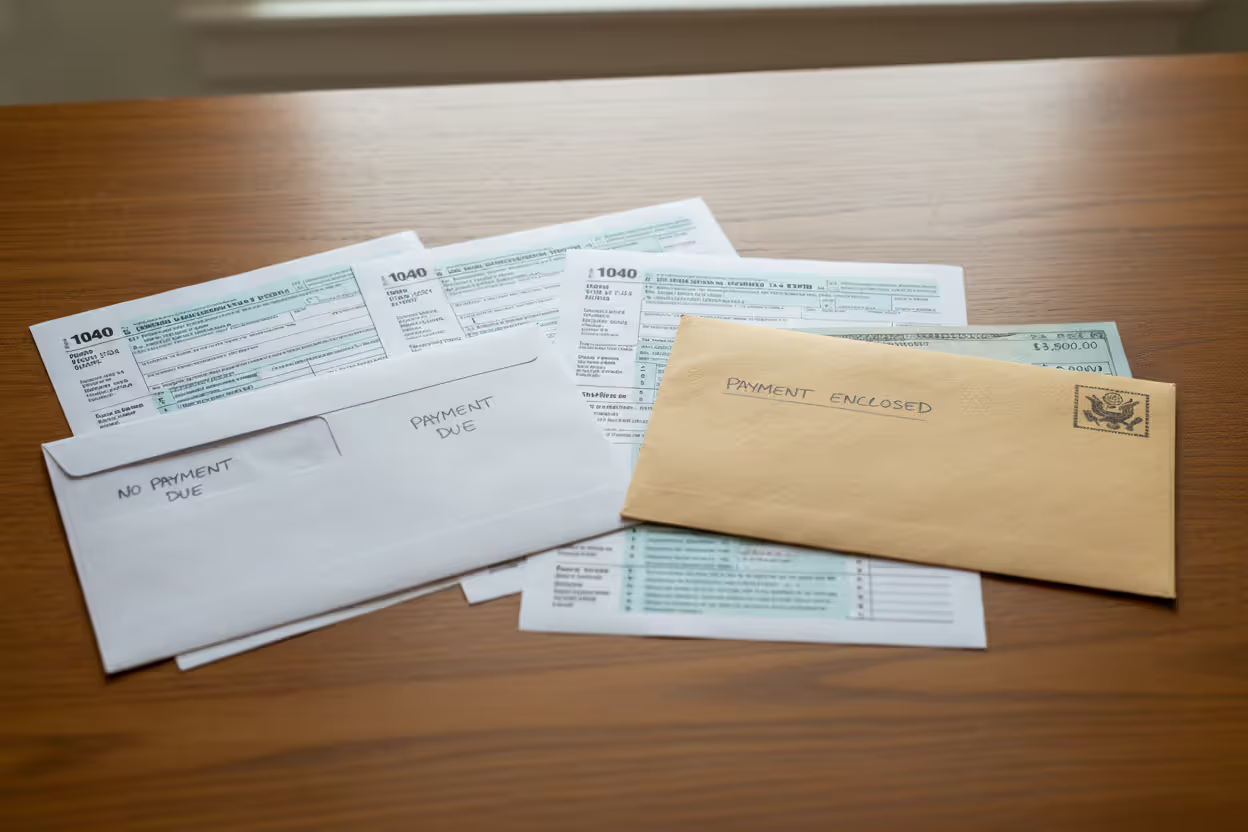
Tax return documents, mailing envelope, and laptop for choosing how to file taxes
Where to File Taxes Based on Your Situation

Getting your tax return to the right place sounds simple, but thousands of filers send their paperwork to the wrong address every year. The IRS handles over 160 million returns annually across multiple processing centers—and if yours lands at the wrong facility, expect your refund to sit in limbo for an extra month or more. Which filing location you need isn't random. It hinges on how you're submitting (paper or electronic), where you live, what form you're using, and a detail many people miss: whether you're including a check.
How Tax Filing Destination Depends on Your Method
Your submission method controls everything about where your paperwork ends up. Let's break down the three ways you can file and what each means for routing.
When you file electronically, you're not mailing anything anywhere. Tax software—whether that's TurboTax, FreeTaxUSA, or the IRS's own platform—transmits your data straight into IRS computer systems. You click "submit," the software packages your information, and it travels through secure channels to IRS servers. Usually within a day, you'll get confirmation the agency received it. No address selection happens on your end because the software already knows the digital destination. This method cuts down on mistakes dramatically since there's no envelope to mis-label and no handwriting for clerks to misread.
Author: Lauren Whitma;
Source: atiservicesoftampa.com
Paper filing works differently. You print your completed return, sign it, stuff it in an envelope, and mail it to one of several IRS processing facilities scattered across the country. Here's where it gets tricky: the address you need changes based on three things. First, which state you filed from. Second, whether you stapled a check or money order to your return. Third, which tax form you're submitting. The IRS shifts these addresses around as they close old centers and open new ones, so what worked last April might bounce back this year.
Take filing in person as your third option. You might sit down with a tax preparer at H&R Block, visit a volunteer site at your library, or walk into an IRS office. Either way, you're handing documents to another human. But they're not the final destination. That preparer will likely e-file your return on their software, which means it takes the electronic route. Sometimes—rarely now—they'll submit your paper forms through internal IRS channels. The method they choose determines where your information ultimately goes.
Here's a real scenario: Two neighbors in Denver both file Form 1040. Sarah owes $850 and writes a check. Mike gets a refund. Same form, same street, same day at the post office. Yet Sarah's envelope needs to go to Utah while Mike's heads to Kansas. The IRS separates these processing streams on purpose, and mixing them up adds processing time.
Finding Your IRS Mailing Address for Tax Return
Pinpointing the right address for your paper return requires checking three factors every single year: where you live, what you're filing, and whether payment's enclosed.
Don't trust your memory on this. The IRS publishes fresh address lists each tax season, usually in January, because they reorganize facilities more often than you'd think. That envelope you saved from last year? Toss it. Seriously.
With Payment vs. Without Payment
The IRS splits incoming mail into two streams right from the start. Returns with checks attached flow to centers equipped with lockboxes and deposit systems. Returns expecting refunds or showing zero balance go to different buildings focused on data processing.
If you're enclosing payment—that means a check, money order, or cashier's check paper-clipped to your 1040—you'll use one set of addresses. These facilities have banking partnerships and move quickly to deposit your payment and credit your account. Speed matters here because the IRS wants to stop the interest clock and prevent automated collection letters from going out.
When you're not including payment, either because you're getting money back or you owe nothing, you'll mail to a separate location. These centers concentrate on data entry and refund processing. They don't need vault space for checks, so the IRS configures them differently.
What happens if you mix these up? Your return won't get lost, but it'll take a detour. Staff at the wrong center will notice the mismatch, log it, and forward your envelope internally. That internal mail system adds 10-21 days to processing time—longer during peak season when forwarding bins overflow.

Author: Lauren Whitma;
Source: atiservicesoftampa.com
State-by-State Address Lookup
Every state connects to specific processing centers. The map doesn't follow logical geography. California returns don't necessarily go to California. New York filers often mail to Missouri. The IRS balances workload across their facilities based on capacity and staffing, not proximity.
Here's how addresses break down for several high-population states:
| State | Returns Without Payment | Returns With Payment |
| California | Internal Revenue Service, Fresno, CA 93888-0002 | IRS, P.O. Box 7704, San Francisco, CA 94120-7704 |
| Texas | Internal Revenue Service, Austin, TX 73301-0002 | IRS, P.O. Box 1214, Charlotte, NC 28201-1214 |
| New York | Internal Revenue Service, Kansas City, MO 64999-0002 | IRS, P.O. Box 37008, Hartford, CT 06176-7008 |
| Florida | Internal Revenue Service, Kansas City, MO 64999-0002 | IRS, P.O. Box 1214, Charlotte, NC 28201-1214 |
Notice New York sends no-payment returns all the way to Kansas City but payment returns to Hartford. Texas routes payment returns to North Carolina even though they have an Austin processing center. This isn't arbitrary—it reflects how the IRS distributes workload across their network.
Never pull addresses from random websites or tax forums. Go straight to IRS.gov and look up the instructions for your specific form. They publish complete address tables in Publication 17 and on individual form instruction pages. Those are updated every year and represent the only truly reliable source.
Where Can I File My Taxes Online
Electronic filing has taken over. About 93% of individual returns now arrive digitally rather than on paper. You've got several paths to e-file, and which one fits depends mostly on your income level and how comfortable you are with tax forms.
IRS Free File partners the agency with brand-name software companies who agree to offer free versions to people earning below certain thresholds. For 2024 tax year returns, that cutoff sits at $79,000 in adjusted gross income. If you qualify, you can use TurboTax, H&R Block, or one of about a dozen other platforms without paying a cent. The catch? You must enter through IRS.gov, not through the company's main website. Go directly to TurboTax.com and you'll hit their paid versions. The IRS portal links you to the genuinely free products.
Above that income limit, you can use Free File Fillable Forms—basically, electronic blank forms you complete yourself. Think of these as interactive PDFs that do basic math for you. They add up your income, calculate your tax, and handle the number-crunching. But you need to know which schedules to attach and how deductions work. No interview questions, no guidance. For experienced filers who just want electronic submission without paying software fees, this works fine.
Commercial software serves everyone regardless of income, with pricing that scales based on complexity. Basic packages for W-2 employees claiming standard deductions might cost $50-60. Add rental properties, investment sales, or business income and you're looking at $120-200. Many companies charge separately for state returns—another $40-50 per state. The software interviews you in plain English, asks about your life situation, and fills out the right forms behind the scenes. TurboTax, H&R Block, TaxAct, and FreeTaxUSA dominate this market, though dozens of smaller competitors exist.
Direct File represents the IRS's newest experiment—a completely free platform run directly by the agency with no middleman software company. Launched as a pilot in 2024, it currently works in 25 states and handles straightforward situations: W-2 income, standard deduction, common credits like Earned Income Credit or Child Tax Credit. No business income, no itemizing, no rental properties. The IRS plans to expand it based on how the pilot performs, but for now it's limited.
Tax professional e-filing means hiring someone to prepare and submit your return electronically. You drop off your W-2s and receipts, they build your return in professional software, and transmit it on your behalf. CPAs, enrolled agents, and even many seasonal preparers at chain offices work this way. You get personal service plus electronic speed. Cost varies wildly—$200-400 for simple returns, $1,000+ once businesses or multiple states enter the picture.
The beauty of electronic filing? You don't choose where to send tax forms. The software knows the digital routing based on your state and form type, eliminating the single biggest source of addressing mistakes.

Author: Lauren Whitma;
Source: atiservicesoftampa.com
In-Person Tax Filing Locations
Despite electronic filing's dominance, face-to-face help still exists for people who want or need human assistance.
VITA—Volunteer Income Tax Assistance operates at thousands of locations nationwide, primarily serving people making $64,000 or less, plus individuals with disabilities and those with limited English. IRS-certified volunteers sit down with you, prepare your return, and e-file it on the spot. Everything's free. You'll find VITA sites at libraries, community centers, schools, and sometimes shopping malls. They typically run January through mid-April, though some year-round sites exist. Find the nearest one through the IRS website or call 800-906-9887. Expect waits during peak season—appointments aren't always available, and walk-in services can mean 2-3 hour waits on Saturdays in March.
TCE—Tax Counseling for the Elderly focuses on filers aged 60-plus, with volunteers specially trained on retirement income, pensions, and Social Security. AARP Foundation Tax-Aide operates most TCE locations. Like VITA, it's completely free and volunteers handle e-filing. You'll find these at senior centers, retirement communities, and libraries. Same time frame: January through April 15, with occasional extended hours as the deadline approaches.
IRS Taxpayer Assistance Centers are actual IRS offices where agency employees work. There are 358 across the country. But these aren't for routine filing. You go here when you've got account problems, payment plan negotiations, or identity theft issues. Staff can help with return preparation in very limited circumstances—usually only when it relates to an existing account problem. You need an appointment (book through IRS.gov or call 844-545-5640), and during filing season, walk-in waits stretch to several hours if they even let you in without an appointment.
Paid preparers range from national chains like H&R Block and Jackson Hewitt to local CPA firms to independent enrolled agents working from home offices. They handle everything from basic W-2 returns to complex multi-state business filings. Most e-file your return, though you can request paper filing if you prefer (they'll usually charge extra for this). Pricing spans a huge range. A single-state, W-2-only return at a chain office might cost $200-300. Bring in a small business, rental properties, or investment accounts and you're looking at $500-1,500+. CPAs at established firms typically charge more than seasonal preparers or enrolled agents.
Choosing in-person help makes sense when your tax situation confuses you, when you've received IRS letters you don't understand, or when you simply feel more comfortable talking through your return with someone who can answer questions in real time.

Author: Lauren Whitma;
Source: atiservicesoftampa.com
Common Mistakes When Choosing Where to Send Tax Forms
Even people who've filed for decades make simple errors that jam up processing.
Reusing old envelopes or addresses ranks as the number-one mistake. You filed last year, the return processed fine, so you figure nothing changed. But the IRS consolidates and shifts processing centers regularly. An address that worked perfectly in 2024 might route to a closed facility or a center no longer handling your state's returns in 2025. Always—every single year—verify the address in current instructions before sealing that envelope.
Confusing payment-status addresses trips up people whose situations vary year to year. Maybe you normally get refunds but this year changed your withholding and now you owe. You habitually use your refund-return address, forgetting that owing money means a different mailing location. Or you refinanced your house and took a big deduction, switching from owing to refund status. That changes your address. Check which category you fall into before addressing the envelope.
Sending the wrong form to the wrong place happens because not all forms share addresses. Your regular Form 1040 goes to one center. Form 1040-X for amending a prior return goes somewhere else. Form 4868 requesting a filing extension has its own destination. Form 1040-NR for nonresident aliens uses different addresses than regular 1040s. Don't assume one address handles all IRS paperwork.
Skimping on postage creates unnecessary problems. Your return with all its attachments—W-2s, 1099s, schedules—often weighs more than one ounce. A single Forever stamp covers one ounce. Anything heavier and the post office returns it to you for insufficient postage. Now you've missed your filing deadline. Weigh your envelope at the post office or use online postage calculators, then add the correct amount. An extra 40 cents in stamps prevents missing deadlines by weeks.
Forgetting signatures doesn't relate to addressing but commonly goes hand-in-hand with mailing errors. An unsigned return can't be processed—period. The IRS will mail it back to you with instructions to sign and resubmit. That round trip eats up 3-5 weeks minimum. Joint returns need both spouses' signatures. Both.
Following outdated internet advice misleads filers who Google "IRS mailing address" and click the first result that isn't IRS.gov. Tax forums, blog posts, and reference sites often contain information from previous years. One taxpayer mailed his return to an address he found on a tax question forum—an address the IRS had stopped using in 2022. His envelope bounced between postal facilities and IRS centers for seven weeks before someone manually routed it correctly. His refund arrived in July instead of March.
I tell every client the same thing: spend five minutes on IRS.gov verifying your mailing address in this year's actual instructions. I've watched too many refunds get delayed by a month or more because someone grabbed last year's envelope from their file cabinet and assumed nothing changed. The IRS moves these addresses around more than people realize
— Jennifer Martinez
State Tax Filing Destinations
Federal and state returns travel completely separate paths. The IRS never touches your state forms. Your state revenue department never sees your federal return. They're parallel systems.
Each state runs its own tax agency with unique addresses, electronic systems, forms, and rules. California operates the Franchise Tax Board. New York has the Department of Taxation and Finance. Pennsylvania runs the Department of Revenue. Nine states don't tax wage income at all: Alaska, Florida, Nevada, South Dakota, Tennessee (phased out wage tax as of 2021), Texas, Washington, and Wyoming. New Hampshire only taxes interest and dividend income above certain thresholds.
Where do you send your state return? Check your specific state's tax agency website—not the IRS. Most states accept e-filing through the same commercial software you use federally. Complete your federal return in TurboTax or H&R Block, and the program offers to prepare your state filing for an additional fee (usually $30-50). When you submit, federal data flows to IRS systems while state data routes to your state's servers. Two destinations, one click.
Paper state returns use completely different addresses than IRS mailings. Your state might process returns in-state or contract with facilities in other states. Wisconsin processes some returns in Illinois. Oregon contracts with a vendor in Missouri. Instructions come with state tax booklets or from the revenue department website.
Certain states require filing even when you owe zero. Others have minimum income thresholds below which you don't file. If you moved during the year, you might file as a part-year resident in two states: one return for January through your move date in State A, another for your move date through December in State B. Sometimes you'll qualify for credits in your new state for taxes paid to your old state to avoid double taxation.
Your state tax filing destination has nothing to do with federal IRS procedures. Never assume state rules mirror federal processes—they rarely do.
FAQ: Where Do I File Taxes
Figuring out where to file taxes boils down to answering a few key questions: Are you filing electronically or on paper? Which state are you in? Are you enclosing payment? What form are you submitting? E-filing sidesteps the whole addressing issue since software routes everything automatically—it's faster, more secure, and eliminates the main source of filing mistakes.
Paper filers need to verify addresses in current-year IRS instructions every time. Don't trust memory, old envelopes, or random websites. Spend five minutes on IRS.gov looking up the current address for your specific situation—payment status and state matter more than most people realize.
The IRS processes your return most efficiently when it arrives at the correct facility on the first try. Wrong addresses mean delays: 2-6 weeks of internal forwarding, phone calls to check on missing refunds, frustration. Whether you submit online through software or IRS Free File, mail paper forms to the proper service center, or work with a volunteer at VITA or a paid preparer, understanding where your return needs to go prevents unnecessary complications.
State returns follow their own paths to state tax agencies—completely separate from federal filing. Amended returns, foreign addresses, extension requests—these all use specific addresses spelled out in official IRS publications. When you're not sure, IRS.gov has current addresses for every situation, and their phone line (800-829-1040) can clarify which destination applies to your circumstances. Getting it right the first time saves weeks of waiting and mountains of aggravation.
Related Stories
Read more
Read more




The content on this website is provided for general informational and educational purposes only. It is intended to explain concepts related to tax filing, tax software, IRS forms, deadlines, and general tax preparation processes.
All information on this website, including articles, guides, and examples, is presented for general educational purposes. Tax filing requirements may vary depending on individual circumstances, income sources, residency status, and applicable laws.
This website does not provide tax, legal, or financial advice, and the information presented should not be used as a substitute for consultation with a qualified tax professional or advisor.
The website and its authors are not responsible for any errors or omissions, or for any outcomes resulting from decisions made based on the information provided on this website.