

Tax documents and laptop prepared for filing taxes
What Forms Do I Need to File My Taxes

What Forms Do I Need to File My Taxes
Here's something most people don't realize until they're halfway through tax season: the paperwork arrives before you're ready to use it. Starting in mid-January, tax documents trickle into mailboxes and email inboxes—sometimes one per week, sometimes five in a single day. Miss just one form, and you're looking at IRS correspondence six months later questioning why your return doesn't match their records.
Last year, the IRS processed 161 million individual returns. About 20% of those returns had errors or missing information. You don't want to join that group. Your tax documentation needs depend on three things: where your money came from, what deductions you're claiming, and your personal circumstances (married, self-employed, homeowner, investor).
The standard 1040 form is just your starting point. Depending on your situation, you might need anywhere from two to twenty different documents. Let's break down exactly which ones matter for your specific circumstances.
Understanding Your Basic Tax Filing Forms
Form 1040 is where everything comes together. Think of it as the cover page of your tax story—just two pages that summarize your entire financial year. The IRS ditched the old 1040A and 1040EZ versions back in 2018, so now everyone uses the same streamlined version whether you're filing a simple return or a complex one.

Author: Benjamin Carte;
Source: atiservicesoftampa.com
But here's the catch: Form 1040 almost never travels alone. It's like the hub of a wheel, with all your other documents as spokes connecting to it. Every dollar of income you earned, every deduction you're claiming, every credit you qualify for—they all feed into specific lines on this form. Your W-2 wages? Line 1. Business income? Line 3. Investment income? Lines 2 and 3. The IRS uses your completed 1040 to determine one crucial number: do you owe them money, or are they sending you a refund?
You'll also work with schedules—these are basically detailed attachments that expand on specific sections of your 1040. Schedule 1 is for additional income (like gambling winnings or jury duty pay) and adjustments (like student loan interest or educator expenses). Schedule 2 covers alternative minimum tax and other less common taxes. Schedule 3 handles nonrefundable credits and any payments you made beyond withholding.
These schedules replaced what used to be dozens of separate forms. The IRS consolidated everything to make filing simpler. Whether that actually worked is debatable, but at least everything connects to your 1040 now instead of floating around as independent documents.
Income-Related Tax Forms You May Need
W-2 and 1099 Forms
Your W-2 shows up by January 31st from every employer who paid you during the tax year. This single document contains everything about your job income: total wages, federal tax withheld, state tax withheld, Social Security and Medicare taxes, contributions to your 401(k), health insurance premiums—the works. If you worked three different jobs last year, you'll receive three separate W-2s.
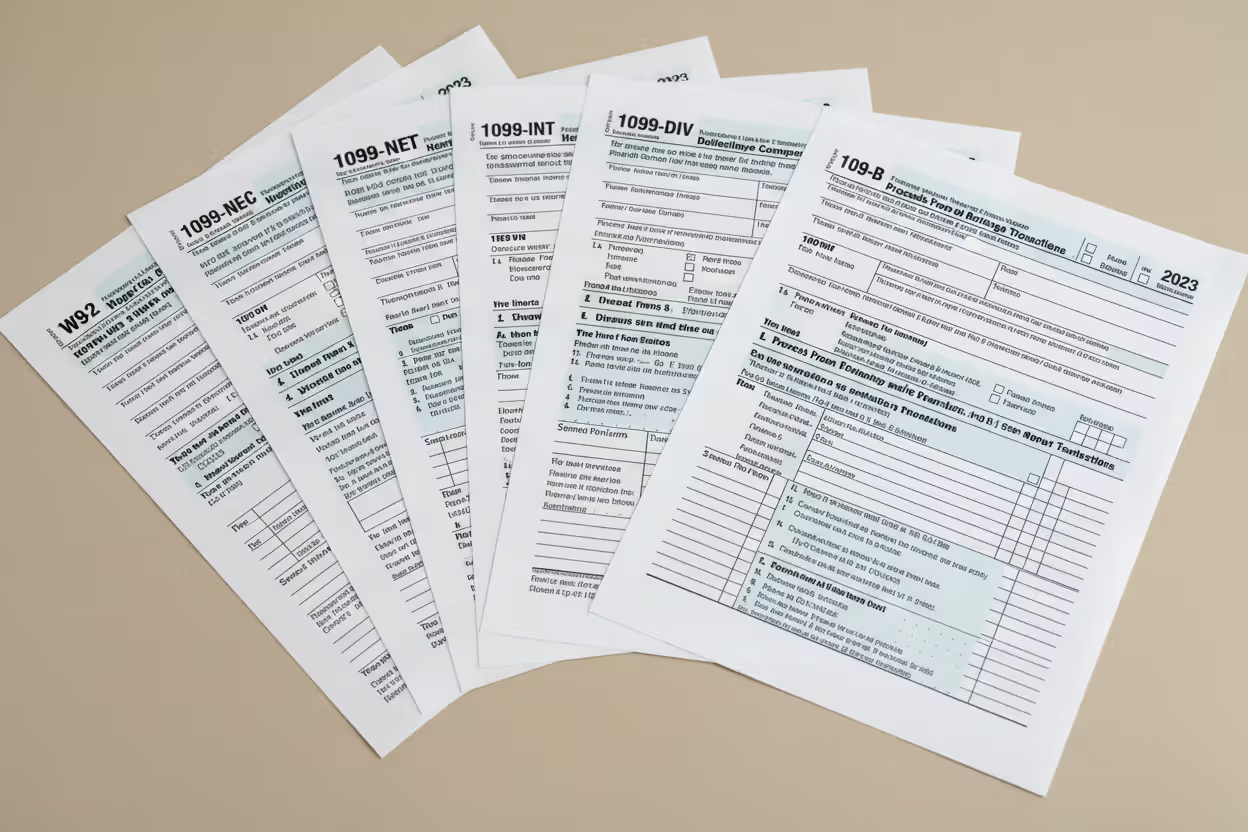
The 1099 family is massive—over 20 different varieties covering every type of non-employment income imaginable. Here are the ones you'll most likely encounter:
1099-NEC went into service in 2020 for independent contractor work. Drive for Uber? You'll get one. Do freelance graphic design? Another one. Sell crafts on Etsy? Yep, if you earned over $600, this form shows up. The threshold is $600 per payer, which means ten different clients paying you $500 each generates zero 1099s, but one client paying $601 triggers reporting requirements.
1099-INT arrives when your savings account, checking account, or certificates of deposit generate more than $10 in interest. Most banks now deliver these electronically through their portals, so check your online banking around late January.
1099-DIV covers dividend payments from stocks, mutual funds, or ETFs in your brokerage account. You'll also see capital gain distributions here—those are profits from securities sold within mutual funds you own.
1099-B gets generated every time you sell investments. Sold 50 shares of Apple stock? It's on there. Cashed out some Bitcoin? That's reportable too. Your brokerage firm reports both your proceeds (what you received) and your cost basis (what you originally paid), which determines your capital gain or loss.
1099-G documents state and local tax refunds, unemployment compensation, or certain government payments. Collected unemployment benefits for three months after a layoff? This form shows the total amount. Received a state tax refund because you overpaid last year? It's reported here, and might be taxable depending on whether you itemized deductions previously.
Author: Benjamin Carte;
Source: atiservicesoftampa.com
Self-Employment and Business Income Forms
Running any kind of business—even a side hustle that brings in $500—means filling out Schedule C. This is where you report gross receipts and deduct business expenses. Website hosting fees, equipment purchases, advertising costs, professional development courses, business mileage, home office space—everything gets documented here.
Schedule SE calculates self-employment tax, which covers your Social Security and Medicare obligations. When you're someone's employee, they pay half these taxes and you pay half. When you work for yourself, you're paying both halves. That's 15.3% on your net business income up to $168,600 (for 2024-2025), then 2.9% on everything above that. It's a hefty bill that catches new freelancers off guard.
If you're in a partnership or own part of an S-corporation, you'll receive Schedule K-1 showing your share of the business profits or losses. These forms are notorious for arriving late—sometimes not until March or even April—because the business entity has to complete its own tax return first before calculating each partner's share. This delay can push your personal filing deadline back if you request an extension.

Author: Benjamin Carte;
Source: atiservicesoftampa.com
Investment and Retirement Income Forms
Form 1099-R documents any money you pulled from retirement accounts. Withdrew funds from your traditional IRA? It's reported here. Took a 401(k) distribution? Same form. The document includes distribution codes that tell the IRS whether you took an early withdrawal (hello, penalties), rolled money to another retirement account (no immediate tax), or qualified for an exception to early withdrawal penalties.
Rental property owners use Schedule E to report rental income and expenses. You'll list rental receipts, then subtract mortgage interest, property taxes, insurance, repairs, lawn care, property management fees, and depreciation. That depreciation piece is tricky—you're required to depreciate the property even if you don't want to, and it affects your taxes years later when you sell.
Sold your home last year? You might receive Form 1099-S reporting the sale price. However, most primary residence sales qualify for capital gains exclusions—$250,000 for single filers, $500,000 for married couples filing jointly—so you often won't owe any tax despite receiving this form. You do need to meet ownership and use tests: owned the home at least two years and lived in it as your primary residence for at least two of the five years before selling.
Common Deduction and Credit Forms
Schedule A is where you itemize deductions when they exceed the standard deduction ($13,850 for single filers, $27,700 for married filing jointly in 2023). You'll list mortgage interest, property taxes up to $10,000, charitable donations, and medical expenses exceeding 7.5% of your adjusted gross income.
Your mortgage lender mails Form 1098 showing interest paid during the year. Donated $500 to your church? You need their acknowledgment letter. Gave $2,000 to the local food bank? Get written confirmation. Medical expense receipts need to be comprehensive—doctor visits, prescriptions, insurance premiums, medical equipment, even mileage driving to appointments at 22 cents per mile.
Schedule C, already mentioned for business income, simultaneously captures your business deductions. Home office deduction, equipment purchases, software subscriptions, professional association memberships, business insurance, continuing education—document everything. There's a simplified home office deduction of $5 per square foot up to 300 square feet ($1,500 maximum), which eliminates the need to calculate the actual-expense method's complicated percentage allocations.
Education credits require Form 1098-T from colleges and universities. The American Opportunity Credit offers up to $2,500 annually per student for the first four years of undergraduate education—40% of it is refundable, meaning you can receive up to $1,000 even if you owe no tax. The Lifetime Learning Credit provides up to $2,000 per tax return (not per student) for any post-secondary education or job skill courses. You calculate these on Form 8863.
The Child Tax Credit now gets figured on Schedule 8812. Each qualifying child under 17 generates a $2,000 credit. Paid for daycare so you could work? Form 2441 calculates the child and dependent care credit, covering daycare centers, after-school programs, and summer day camps (but not overnight camps).
Made energy-efficient home improvements? Form 5695 calculates credits for solar panels, solar water heaters, geothermal heat pumps, or biomass stoves. Solar installations can earn you 30% of the cost with no upper limit—install a $30,000 solar system and receive a $9,000 tax credit.

Author: Benjamin Carte;
Source: atiservicesoftampa.com
Which Tax Forms Do I Need Based on My Situation
Traditional employees typically need just their W-2, Form 1040, and potentially Schedule A if itemizing beats taking the standard deduction. With straightforward finances—one employer, no side income, minimal investments—tax prep stays manageable. Most use tax software and finish in under two hours.
Freelancers and gig workers collect multiple 1099-NECs from different clients, complete Schedule C for each separate business, and calculate self-employment tax on Schedule SE. Don't forget Form 1040-ES if you made quarterly estimated tax payments. Many independent contractors overlook the qualified business income deduction on Form 8995, which can slice up to 20% off your taxable business income if you qualify.
Homeowners receive Form 1098 from their mortgage lender showing interest paid. If you pay property taxes through escrow, those might appear on the same 1098 or a separate one. Refinanced during the year? Expect two different 1098s from the old lender and the new one. Keep in mind: home equity loan interest is only deductible if you used the borrowed money for substantial home improvements, not for buying a car or paying off credit cards.
Investors juggle numerous documents: 1099-DIV for dividends, 1099-INT for interest, 1099-B for securities sales, and Schedule D for calculating capital gains and losses. Trading cryptocurrency? Form 8949 requires documenting every single sale, exchange, or conversion—exhausting if you made hundreds of trades. Tax software helps, but you need accurate records from every exchange platform you used.
Students need Form 1098-T plus receipts for qualifying educational expenses. Student loan holders receive Form 1098-E showing interest paid, potentially qualifying for a deduction up to $2,500 even if you don't itemize. Watch out: scholarships and grants appear on 1098-T, but they become taxable when used for non-qualified expenses like room and board.
Retirees typically collect Form 1099-R for pension and IRA distributions, Form SSA-1099 for Social Security benefits, plus various 1099-INT and 1099-DIV forms from investment accounts. Social Security becomes partially taxable once your combined income tops $25,000 (single) or $32,000 (married filing jointly). Form 1040-SR is specifically designed for filers 65 and older with larger print and a built-in standard deduction chart, though using it is optional.
Common Tax Forms by Income Type
| Income Source | Form Number | Who Gets It | What You Do With It |
| Wages from employment | W-2 | Anyone on an employer's payroll | Attach to your return |
| Freelance/contract work | 1099-NEC | Self-employed earning $600+ from one payer | Report on Schedule C |
| Interest from savings | 1099-INT | Accounts earning $10+ in interest | Use Schedule B if over $1,500 total |
| Stock dividends | 1099-DIV | Investors receiving $10+ in dividends | Use Schedule B if over $1,500 total |
| Investment sales | 1099-B | Anyone selling stocks, bonds, crypto | Report on Schedule D |
| Retirement distributions | 1099-R | Anyone withdrawing from retirement accounts | Include all distributions on return |
| Unemployment benefits | 1099-G | Recipients of unemployment compensation | Report as taxable income |
| Social Security payments | SSA-1099 | Social Security beneficiaries | Include if income exceeds thresholds |
| Rental property revenue | None (self-reported) | Landlords and property owners | Complete Schedule E |
| Mortgage interest paid | 1098 | Homeowners with mortgages | Needed for Schedule A itemizing |
How to Obtain Missing or Lost Tax Forms
Employers and financial institutions sometimes miss deadlines, forms get lost in the mail, or you move and forget to update your address. By mid-February, if an expected W-2 hasn't shown up, contact your employer's payroll department directly. They're legally required to provide it, and most can email or print a replacement copy immediately.
Missing a 1099? Reach out to whoever issued it—your bank, brokerage firm, or the client who paid you. Many companies have gone fully digital, and your form might be sitting in an online account portal waiting for you to download it. Check your bank's website or investment account dashboard before assuming it wasn't issued.
The IRS offers several ways to retrieve tax information. Creating an account at IRS.gov gives you access to wage and income transcripts showing most income reported to them. These transcripts don't replace the actual forms, but they confirm what information the IRS has on file. There's a processing lag, though—current-year data might not appear until late February or early March.

Author: Benjamin Carte;
Source: atiservicesoftampa.com
Prefer mail? Submit Form 4506-T requesting a wage and income transcript by mail. The IRS usually processes these within ten business days, though during peak season (February through April), delays happen frequently.
What if your W-2 never arrives and your employer went out of business or won't respond? File Form 4852 (Substitute for Form W-2) with your return. Use your final pay stub from December to estimate wages and withholding. Fair warning: this flags your return for manual review, delaying any refund by several weeks or months.
A missing 1099 doesn't exempt you from reporting that income. Tax law requires reporting all income whether you received documentation or not. Use your own records—bank statements, PayPal reports, invoices, deposit records—to determine accurate amounts. The IRS cross-checks reported income against your return, so omitting income because you lack a form creates bigger problems down the road.
Tax Forms Checklist Before You File
Start by reviewing last year's return to build a list of expected forms. Did ABC Corporation send you a W-2 last year and you still work there? Expect another one. Earned bank interest last year? Another 1099-INT is coming.
Author: Benjamin Carte;
Source: atiservicesoftampa.com
Check that every form shows your correct Social Security number and current legal name. Mismatches between your return and information reports cause processing delays. Changed your name after getting married? Update it with the Social Security Administration before filing taxes, or use your prior legal name on the return to match their records.
Cross-reference your forms against IRS deadlines. W-2s and most 1099 forms are due January 31st. Investment sales on 1099-B have a February 15th deadline. Partnership K-1s often don't arrive until mid-March because the partnership must file its return first. If an overdue form hasn't arrived, don't wait indefinitely—use the retrieval methods explained earlier.
Compare your personal records against received forms. Your final December paycheck should match your W-2 gross wages within a few dollars. Bank statements should align with your 1099-INT figures. Discrepancies might indicate errors or missing documents.
Organize forms by category: stack all W-2s together, group all 1099s, separate all deduction receipts. This organization accelerates data entry whether you're using tax software, hiring a preparer, or filling out paper forms.
Review prior returns for carryforward items. Capital loss carryovers, net operating losses, education credits spanning multiple years, and unused alternative minimum tax credits all carry forward from previous years. Your prior year return should note any amounts carrying forward.
People rush to file in early February using only their W-2, then a 1099-B shows up in March. Now they're filing an amended return, which delays their refund by months and increases their chances of IRS scrutiny. Waiting three extra weeks to gather all documents prevents major headaches
— Marcus Chen
Frequently Asked Questions About Tax Filing Forms
Getting all your tax documents together before you start filing prevents delays, penalties, and the hassle of filing amended returns. Your specific needs depend entirely on your income sources and financial transactions—there's no universal checklist that works for everyone. Start with Form 1040 as your foundation, then add income documentation (W-2s and 1099s), schedules for additional income or deductions, and forms for any credits you qualify for.
Most people need more documentation than they initially expect. That freelance project that paid $800? You need a 1099-NEC and Schedule C. The $150 in savings account interest? It's reportable despite seeming trivial. Those new energy-efficient windows you installed? Form 5695 generates a tax credit.
Create your personalized checklist using last year's return and accounting for any financial changes this year. Contact issuers about missing forms by mid-February. Use IRS transcripts and your personal records to fill gaps when necessary. Organize everything thoroughly before you start entering data, whether you're using software or working with a tax professional.
The extra time invested gathering complete documentation beats spending months dealing with IRS notices about unreported income or missed deductions. Accurate first-time filing paired with thorough recordkeeping transforms tax season from a stressful ordeal into a manageable task.
Related Stories

Read more

Read more




The content on this website is provided for general informational and educational purposes only. It is intended to explain concepts related to tax filing, tax software, IRS forms, deadlines, and general tax preparation processes.
All information on this website, including articles, guides, and examples, is presented for general educational purposes. Tax filing requirements may vary depending on individual circumstances, income sources, residency status, and applicable laws.
This website does not provide tax, legal, or financial advice, and the information presented should not be used as a substitute for consultation with a qualified tax professional or advisor.
The website and its authors are not responsible for any errors or omissions, or for any outcomes resulting from decisions made based on the information provided on this website.