

Person reviewing overdue U.S. tax documents at a desk
How to File Previous Years Taxes for Free

Skipped filing taxes last year? Maybe the year before that too? You're not stuck paying $200+ to a tax preparer or software company to fix it.
Millions of Americans leave tax returns unfiled—sometimes for years. The reasons vary: job loss, family emergencies, simple procrastination, or confusion about what to do when you've already missed the deadline. Here's what matters: catching up won't cost you a dime if you know where to look.
What follows is your complete roadmap for submitting those overdue returns without opening your wallet. You'll learn which forms you need, where to find them, and how to avoid the traps that cost people time and money.
Why You Need to File Old Tax Returns
The IRS penalty calculator runs automatically once you've missed an April deadline. They charge 5% of unpaid taxes for each month you delay filing, capping at 25% total. That's on top of the taxes you actually owe. A $3,000 tax bill becomes $3,750 within five months if you don't file.

Author: Benjamin Carte;
Source: atiservicesoftampa.com
Here's the painful part about refunds: the government sets a three-year countdown clock starting from your original deadline. Submit your paperwork after time expires, and your refund gets absorbed into the Treasury. Recent IRS reports identified $1.5 billion sitting unclaimed because people filed too late. The average abandoned refund? About $893—hardly pocket change.
Unfiled returns block more than you'd expect. Try getting a mortgage without tax transcripts from the past two years. Lenders won't touch your application. Same goes for business loans, federal student aid, and increasingly, apartment leases in competitive markets. I've watched people lose a refinance approval—costing them $14,000 in interest savings—because they skipped filing a year when they owed zero tax.
Your audit exposure stays open indefinitely until you file. Normally, the IRS has three years after you submit a return to audit it. Don't submit anything? That clock never starts. They can review your finances from 2015, 2010, or even 2005 if those years remain unfiled. Filing late closes this vulnerability immediately.
Criminal prosecution for tax evasion targets people who deliberately hide income, not those who missed paperwork deadlines. The IRS criminal investigation division makes this distinction clear. Submitting late returns—even five years late—demonstrates you weren't trying to evade taxes. You just fell behind.
Expecting money back? You're only giving up time, not cash. According to IRS statistics, roughly 75% of taxpayers receive refunds averaging $2,800. Those overdue returns might be holding your money hostage.
Taxpayers who are due refunds have nothing to lose by filing, and they may have money coming back to them. However, they need to file within three years to claim those refunds
— IRS Taxpayer Advocate Service
Where to Get Free Tax Forms for Past Years
IRS.gov keeps a digital archive stretching back decades under "Forms & Instructions." Filter by year, and you'll access every schedule and worksheet from that filing season. Don't grab this year's Form 1040 for last year's taxes—each version reflects different tax law, and using the wrong year guarantees processing headaches.
Tax forms evolve constantly. The 2021 Form 1040 included pandemic-related credits that vanished by 2023. Standard deduction amounts jump yearly. Filing a 2022 return requires the 2022 form set, period. The IRS systems will reject mismatched years or, worse, process them incorrectly and send you months of confusing letters.
Tracking down old W-2s and 1099s poses bigger challenges. Employers must provide duplicates when asked, but many shred records after seven years. Your fastest route: log into your IRS account at IRS.gov/account. Pull up the "Wage & Income Transcript," which displays employer and financial institution reports for the past decade.
Missing information from your transcript? Submit Form 4506-T by mail to request complete records. You'll wait 5-10 business days—slower than downloading transcripts online, but effective. Need faster service? Call the IRS practitioner priority line at 800-908-9946, though you might sit on hold for 45 minutes.
State tax departments run separate websites with their own archives. California's Franchise Tax Board archives differ from New York's Department of Taxation. Texas residents skip this headache—no state income tax. Don't assume your federal filing satisfies state requirements automatically. Most states want separate returns using their forms.
Watch out for unofficial form websites. Some bundle downloads with software trials or upsells disguised as "required preparation tools." Stick to IRS.gov or major tax software company sites to ensure you're getting authentic, unmodified forms.

Author: Benjamin Carte;
Source: atiservicesoftampa.com
Free Methods to File Back Tax Returns
| Method | Cost | Years Available | Pros | Cons |
| IRS Free File | $0 | Current tax year exclusively | Electronic submission, built-in math checkers | Prior years locked out entirely |
| Mail Submission (Paper) | Postage only (~$0.75) | Every year dating back decades | Works universally, no technology required | 8-12 week wait, manual math, higher error risk |
| Tax Software (Discount Versions) | $0-$50 | Typically 3-4 recent years | Step-by-step guidance, imports data | Year availability expires, state returns often cost extra |
| VITA/TCE Volunteer Sites | $0 | Current year plus previous 3-4 | Face-to-face help, zero fees | Income caps apply, appointments scarce Jan-April |
IRS Free File for Current Year Only
The IRS Free File partnership with tax software companies covers one year only: the current filing season. Once January 1st arrives, last year becomes "prior year" and drops out of the program. This trips up countless taxpayers who discover it on February 10th when trying to file their 2024 taxes.
Eligibility extends to anyone earning under $79,000 in 2026. Above that threshold, you can access Free File Fillable Forms—essentially digital versions of paper forms with basic arithmetic but zero hand-holding through the process.
Paper Filing by Mail
Mailing paper returns remains your only genuinely free option for most years you've missed. Download the forms from IRS.gov, fill them out by hand or type into the PDFs, print everything, sign it, and mail to the address printed in the form's instructions. Different states route to different IRS processing centers, and the address changes if you're enclosing payment.
Expect 8-12 weeks before the IRS processes paper submissions versus roughly 3 weeks for electronic filing. Staff manually key in paper data, opening the door for transcription errors. Keep photocopies of absolutely everything you send.
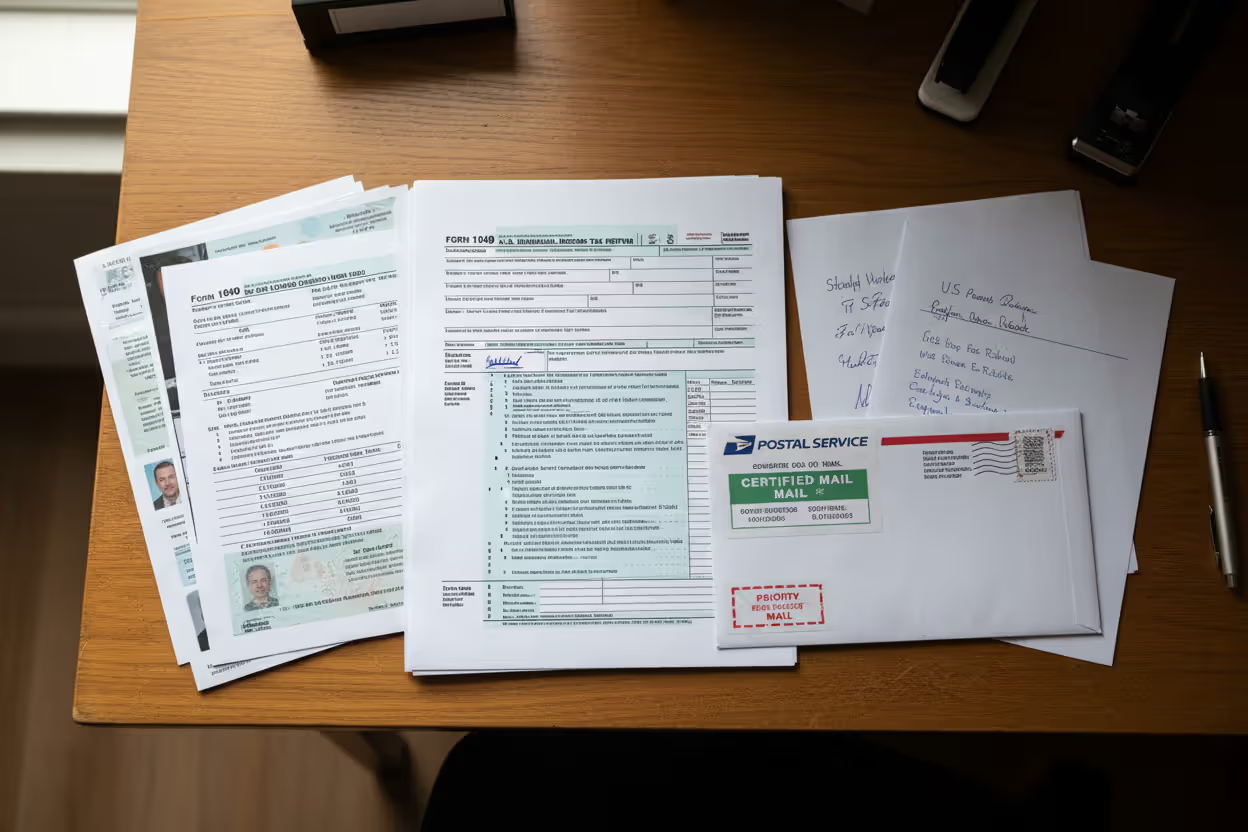
Consider spending $8 on certified mail with return receipt. You'll get legal proof showing the IRS received your return on a specific date—invaluable if penalty disputes arise later. Regular mail offers no such protection.
Free Tax Software Alternatives for Prior Years
A handful of software companies maintain prior-year filing capabilities at reduced prices or free for straightforward returns. FreeTaxUSA charges nothing for federal returns regardless of year, though state returns cost $14.99 each. TaxAct occasionally drops prior-year fees during summer when business slows.
The limitation: companies must maintain old tax calculations. Most support 3-4 prior years before discontinuing updates. You won't find 2016 returns available on 2026 software.
Check each provider's support pages directly for prior-year options. Marketing focuses entirely on current-year filing, burying prior-year information in FAQ sections.
VITA and TCE Programs
Volunteer Income Tax Assistance sites and Tax Counseling for the Elderly locations provide face-to-face preparation assistance for free. IRS-certified volunteers work from libraries, community centers, and churches between January and April (some operate year-round).
VITA serves people earning under $64,000, individuals with disabilities, and those with limited English proficiency. TCE focuses on taxpayers 60 or older. Both will typically prepare your current return plus 3-4 prior years.
The catch: appointments vanish fast, and volunteers might lack experience with complicated scenarios like rental income, stock option exercises, or multi-state tax situations. Straightforward W-2 wage returns are their strength. Find locations using the IRS VITA Locator Tool, and bring every relevant document—ID, Social Security cards, income forms, receipts for deductions, and bank details for refund deposits.

Author: Benjamin Carte;
Source: atiservicesoftampa.com
Step-by-Step Process to File Unfiled Returns
Begin by collecting every financial document from the year you're filing. Bank statements, paystubs, investment account statements, mortgage interest forms (1098), and receipts proving deductible expenses all strengthen your filing. More documentation equals more legitimate deductions.
Pull IRS transcripts for every unfiled year. These reveal what the IRS already knows—W-2 wage reports, 1099 interest and dividend statements, and other third-party income documentation. Your submitted return must account for all this income at minimum, or you'll trigger correspondence asking about discrepancies.
Establish your filing status based on your marital situation on December 31st of that tax year. Got married in June 2023? You're considered married for all twelve months and can file jointly. Divorced in November 2024? You're single for the entire year.
Tally up income from every source: employer wages, freelance earnings, interest from savings accounts, stock dividends, capital gains from investments, IRA or 401(k) distributions. Each income category occupies specific lines on Form 1040. Wages go on line 1, interest on line 2b, and so forth following the form instructions.
Decide between claiming the standard deduction or itemizing. For 2025 taxes (filed during 2026), single filers got a $14,600 standard deduction while married couples filing jointly received $29,200. Itemize only when your mortgage interest, state/local taxes, charitable contributions, and medical expenses combined exceed those amounts.
Fill out forms using that specific year's instructions. Tax brackets shift annually. Deduction limits change. Credit calculations get updated. A 2022 return follows 2022 rules, not 2026 rules, even though you're filling it out in 2026.
Sign and date every return. Unsigned forms get rejected automatically. Joint filers need both spouse signatures. Write your Social Security number on each page in case papers separate during IRS processing.
Mail returns to the address listed in that year's form instructions—not a generic IRS address. Different states route to different processing centers, and "with payment" versus "refund due" returns go to different addresses. Triple-check before sealing the envelope.
Submit multiple years in chronological order. The IRS prefers receiving 2022 before 2023 before 2024. Their systems apply credits and calculate compounding penalties based on sequence. Out-of-order filing creates confusion in their databases.
Track your mailing using certified mail receipts. The IRS won't confirm receipt of paper returns unless you include a stamped, self-addressed postcard listing what you've enclosed. They'll date-stamp it and return it as your proof of filing.
Author: Benjamin Carte;
Source: atiservicesoftampa.com
Common Mistakes When Filing Old Tax Returns
Grabbing current-year forms for past-year taxes ranks as the number one error. A 2026 Form 1040 is useless for 2023 taxes. The IRS will either bounce it back or process it incorrectly under current-year rules, spawning months of back-and-forth letters.
Wrong mailing addresses delay everything by weeks. Instructions for each form list multiple addresses determined by your state and whether you're enclosing payment. Verify twice before mailing.
Forgotten signatures invalidate the entire return. The IRS mails it back, adding 6-8 weeks to your timeline. Keep copies before mailing so you won't have to reconstruct everything from scratch.
Out-of-sequence filing confuses IRS computers. Owe taxes for both 2022 and 2023? File 2022 first. Credits earned in 2022 might reduce your 2023 liability, but only when processed in proper order.
Neglecting state returns creates a separate mess. Most states with income taxes require independent returns filed separately from federal paperwork. California, New York, and Illinois aggressively chase unfiled state returns with their own penalty structures.
Overlooking estimated tax payments you already made. Quarterly estimated payments during the year count toward your final bill. Include Form 1040-ES payment records or check IRS transcripts to verify amounts already paid.
Chasing refunds outside the three-year window. Filing a 2022 return in 2026 puts you past the April 2025 refund deadline. You should still file to avoid penalties and close the year, but the IRS keeps your refund.
What Happens After You File Back Returns
Paper return processing takes 8-12 weeks under normal circumstances. During peak season spanning January through April, expect 12-16 weeks. The "Where's My Refund?" tracking tool only works for current-year returns. For prior years, you'll wait for postal mail from the IRS.
Refund deadlines are unforgiving: three years from the original due date or two years from when you actually paid the tax, whichever comes later. File a 2022 return during 2026, and you've blown past the April 2025 cutoff. The IRS will process your return but retain your refund permanently.
Owe money instead? The IRS mails a bill showing penalties and interest added to your base tax. The failure-to-file penalty runs 5% monthly, maxing at 25%. Failure-to-pay penalties tack on 0.5% monthly. Interest compounds daily using the federal short-term rate plus 3 percentage points.
Payment plans break large bills into manageable chunks. The IRS approves installment agreements stretching up to 72 months. Apply online at IRS.gov/payments or phone 800-829-1040. Setup fees range from zero to $225 depending on how you pay and your income bracket.
Amended returns fix mistakes discovered after filing. Use Form 1040-X within three years of your original return's due date or two years from when you paid the tax. Amendments crawl through processing in 16-20 weeks.
Audits remain possible after processing completes. Prior-year returns face identical audit risk as current returns—roughly 0.4% for typical taxpayers. Keep supporting documentation for at least three years post-filing to handle potential audits.
State tax agencies operate independently from federal systems. Filing your federal return doesn't automatically update state records. Most states demand separate submissions and impose their own penalties. California's Franchise Tax Board, for example, charges businesses an $800 minimum annual tax regardless of whether they earned income.
Frequently Asked Questions About Filing Past Tax Returns
Filing overdue taxes for free demands patience and organization, but the actual process is straightforward once you grasp the steps. Paper filing eliminates software expenses, IRS transcripts replace lost documents, and VITA programs deliver expert assistance at zero charge for eligible taxpayers.
Avoiding unfiled returns creates consequences that dwarf the effort required to complete them. Penalties compound every month, refunds vanish after three years, and financial opportunities—mortgages, business loans, rental applications—slam shut. Whether you owe money or expect a refund, filing clears your record and halts penalty accumulation.
Tackle your oldest unfiled year first, then move forward chronologically. Gather documents, download correct-year forms, and mail returns in sequence. Most people find the process takes less time than anticipated—particularly for simple wage returns claiming the standard deduction.
Facing multiple unfiled years or complicated tax situations? Visit a VITA location or consult an enrolled agent. Many provide free initial consultations to assess whether you genuinely need paid assistance. The relief from resolving unfiled returns delivers value far exceeding the hours invested in paperwork.
Related Stories

Read more

Read more




The content on this website is provided for general informational and educational purposes only. It is intended to explain concepts related to tax filing, tax software, IRS forms, deadlines, and general tax preparation processes.
All information on this website, including articles, guides, and examples, is presented for general educational purposes. Tax filing requirements may vary depending on individual circumstances, income sources, residency status, and applicable laws.
This website does not provide tax, legal, or financial advice, and the information presented should not be used as a substitute for consultation with a qualified tax professional or advisor.
The website and its authors are not responsible for any errors or omissions, or for any outcomes resulting from decisions made based on the information provided on this website.