

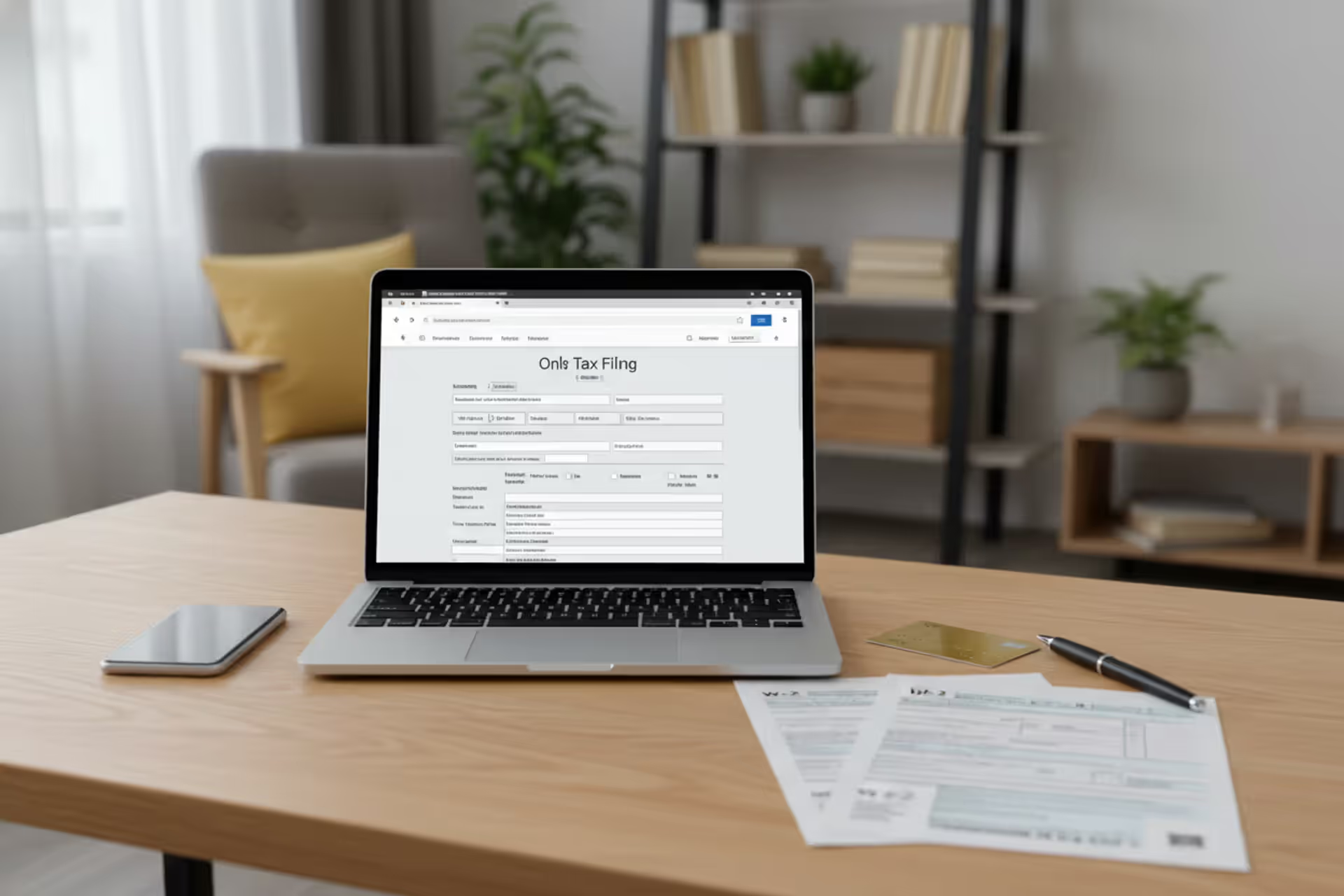
Laptop with tax documents and financial paperwork on a desk
Free Tax Filing for Low Income Taxpayers Guide

Content
Content
Here's something frustrating: about 22 million Americans could file their taxes completely free but end up paying anyway. They'll spend $150, $200, sometimes $300 on tax prep when the IRS already partners with companies that would do the same work for nothing. The catch? You need to know these programs exist, figure out if you qualify, and—this is where it gets tricky—pick the right one for your specific tax situation.
Who Qualifies for Free Tax Filing
Your adjusted gross income determines everything. For tax year 2025 (the return you'll file in early 2026), the magic number sits at $79,000 AGI. Earn that amount or less? You're in. Earn $79,001? You're shopping for paid options or hunting for workarounds.
Here's what makes this simpler than it sounds: filing status doesn't matter. Single person making $78,000? You qualify. Married couple with $78,000 combined? You also qualify. Head of household at $78,000? Same deal. The IRS draws one line for everyone.
Now for the exceptions that actually help people:
Military families get special treatment. Active duty service members earning up to $79,000 qualify automatically—and we're talking active Guard and Reserve on Title 10 orders too, not just regular Army, Navy, Air Force, Marines, or Space Force. Some tax companies sweeten the deal further, letting military families file free even above that threshold. It changes company to company, year to year.
Older taxpayers sometimes catch a break. Hit 51 and certain providers will prepare your return free even if you're earning above the standard cutoff. Don't count on this universally, though. These age-based offers shift every filing season, so what worked last year might disappear this year.
When disasters strike your area, watch for temporary changes. After hurricanes, wildfires, or floods trigger federal disaster declarations, the IRS sometimes loosens the rules. They might bump up income limits or add free services specifically for affected counties. These don't last long—usually just that tax season—but they help when you need it most.
Let's clear up the income confusion. Your AGI isn't the number in Box 1 of your W-2. It's not your total earnings. Line 11 of Form 1040 shows AGI: all your income minus things like IRA contributions, student loan interest payments, or health savings account deposits. Someone grossing $85,000 who puts $7,000 into a traditional IRA? Their AGI drops to $78,000. They qualify.
Geography doesn't enter the equation for federal filing. Live in Puerto Rico? Stationed in Germany with the military? Working abroad as an expat? Your AGI matters, your location doesn't. State returns work differently, but that's a separate issue we'll tackle in a minute.

Author: Derek Langston;
Source: atiservicesoftampa.com
IRS Free File vs Free File Fillable Forms
The IRS splits its free filing program into two completely different experiences, and mixing them up wastes hours.
Eight private companies offer their regular tax software free to anyone making $79,000 or less. These are the "guided software products." You answer questions like "Did you pay for childcare?" and "Do you own a home?" The software figures out which forms you need, does all the math, catches obvious mistakes, and sends everything electronically to the IRS. It's the same software people pay $60 or $120 to use, just unlocked for free when you access it through the IRS portal.
Then there's the other option: Free File Fillable Forms. Anyone can use these—no income limit, no restrictions. But here's what you're getting: electronic tax forms that add numbers for you. That's it. The system won't tell you which forms to fill out. It won't explain whether you qualify for the Earned Income Tax Credit. It won't stop you from claiming deductions you don't actually qualify for. It adds column A to column B and transfers certain numbers from Form 1040 to Schedule 1. That's the extent of the help.
Think of it this way: guided software is like TurboTax for free. Fillable forms are like paper forms that happen to calculate totals automatically.
Most people earning under $79,000 should use guided software. Got W-2 income, a couple kids, and you're claiming the standard deduction? The interview-style questions walk you through everything in 45 minutes. The platform automatically determines you qualify for Child Tax Credit, calculates the amount, and fills out the right forms.
Fillable forms make sense for tax professionals doing their own returns, or for people who genuinely know tax code. A CPA making $150,000 with straightforward finances can knock out fillable forms in twenty minutes. A restaurant server making $32,000 with two kids and daycare expenses? That person will struggle mightily without the guided questions.
One rule protects you with guided software: once you start a federal return through an IRS Free File partner, they cannot charge you for federal filing. Period. State returns follow different rules—they can charge for those. But your federal return stays free from the first screen through e-filing.
The hardest thing in the world to understand is the income tax.” This well-known line captures exactly why so many people overpay for help they may not need: taxes feel confusing, technical, and easy to get wrong, even when free filing options already exist
— Albert Einstein
Free Tax Filing Programs by Provider
Tax companies offer free versions outside the official IRS partnership too, each with its own rulebook.
TurboTax Free Edition lets anyone file free—no income limit—but only for extremely simple returns. We're talking W-2 income, maybe some interest from your savings account, the standard deduction, and either the Earned Income Tax Credit or Child Tax Credit. That's the whole menu. Add self-employment income? Pay up. Sell some stock? Pay up. Itemize deductions? Pay up. TurboTax separately participates in IRS Free File with a $43,000 AGI cap but broader features for people under that threshold.
H&R Block Free Online accepts as many W-2s and 1099s as you've got. It handles Earned Income Tax Credit, Child Tax Credit, and student loan interest deduction. Still no income ceiling, but the "simple return" requirement disqualifies most complex situations. The upside: one free state return, which beats most competitors. H&R Block's IRS Free File version serves up to $79,000 AGI and includes moderately complex returns like limited self-employment income.
Cash App Taxes changed the game. Completely free federal and state filing for everything. Self-employment income? Free. Stock sales? Free. Rental properties? Free. Itemized deductions? Free. No income limits, no restrictions, no gotchas. They make money from Cash App's payment processing and banking services, so they don't need to charge for tax prep. If you've got a complicated return and make too much for IRS Free File, Cash App Taxes often becomes your best shot at free filing.

Author: Derek Langston;
Source: atiservicesoftampa.com
FreeTaxUSA handles any income level and all tax situations for free federal filing, then charges $14.99 per state. The interface looks dated compared to TurboTax—we're talking early 2010s web design—but it works fine for complex returns. If you live in Florida, Texas, Washington, or one of the other states without income tax, you're filing completely free. For everyone else, fifteen bucks isn't bad.
IRS Free File partners include smaller companies like FileYourTaxes.com, 1040Now, and ezTaxReturn. Income limits range from $43,000 to $79,000 depending on the partner. Some specialize in military families, others offer Spanish-language interfaces or focus on specific age groups. The IRS website includes a matching tool—you enter your AGI, state, and situation, it shows which partners accept you.
State Tax Filing Considerations
State return fees ambush people every single year. The software advertises free filing, you spend an hour entering information, then the final screen announces: "$44.99 for your state return."
Here's who actually includes free state filing: Cash App Taxes (always, all situations), H&R Block Free Online (one state, simple returns only), and certain IRS Free File partners (check individually). TurboTax wants $39 to $49 for state returns even when federal is free, though their Free File version includes one free state return.
Nine states don't have income tax: Alaska, Florida, Nevada, South Dakota, Tennessee, Texas, Washington, Wyoming, and New Hampshire (New Hampshire only taxes interest and dividends, and that's ending in 2025). Lucky residents of these states avoid the whole state filing fee question.
Multiple state returns get expensive fast. College kid who worked summer retail in Pennsylvania, goes to school in Ohio, and maintains New Jersey residency? That's potentially three state returns at $40 each through most commercial software. You're spending $120 on state filing alone. Cash App Taxes or certain IRS Free File partners become the only realistic free options.
Military members sometimes skip state returns entirely thanks to the Servicemembers Civil Relief Act. You maintain home-state tax residency regardless of where the military stations you. Stationed in California but claim Texas residency? You might file no state return at all.
Check state costs before typing a single number into tax software. That $40 difference matters when your household brings in $35,000 annually.
VITA and TCE Free In-Person Tax Help
Some people prefer sitting across from an actual human, especially if computers aren't their thing or English isn't their first language. Two IRS programs handle this.
VITA—Volunteer Income Tax Assistance—sets up shop in libraries, community centers, schools, even shopping malls during tax season. IRS-certified volunteers prepare returns for anyone making $67,000 or less, people with disabilities, and limited English speakers. The program specifically targets underserved communities, with many sites running evening and weekend hours in February and March.
TCE—Tax Counseling for the Elderly—focuses on taxpayers 60 and older, with expertise in pension and retirement questions. AARP Foundation runs the biggest TCE operation through Tax-Aide, available at senior centers nationwide. No income restrictions here, though the program naturally serves lower and middle-income seniors.
Both prepare federal and state returns at zero cost. Volunteers use professional-grade software, the same tools paid preparers use. Every return gets checked by a second volunteer before filing—basic quality control that catches math errors and missed deductions.
Finding locations takes two minutes. Visit the IRS website's VITA/TCE locator, call 800-906-9887, or dial 211 for community services. Sites typically open late January and close by April 15th. Many require appointments, some take walk-ins. Call ahead.
Bring these documents or volunteers can't help you:
- Photo ID for yourself and your spouse
- Social Security cards for everyone you're listing on the return
- Every income document—all W-2s, all 1099s, unemployment statements, everything
- Last year's tax return
- Bank account and routing numbers for direct deposit
- Receipts supporting deductions or credits—childcare expenses, education costs, medical bills
- Health insurance forms (1095-A, 1095-B, or 1095-C)
VITA and TCE volunteers handle most common tax situations but not everything. Very complex business losses, foreign income reporting, or intricate investment portfolios exceed volunteer training. They'll tell you upfront if your return is too complicated and suggest alternatives.
The face-to-face format offers something software can't: a knowledgeable person who can spot credits you didn't know existed. Volunteers regularly find extra deductions or identify eligibility for programs that add hundreds to refunds. For elderly taxpayers or anyone with limited English proficiency, this beats clicking through software screens in a language that doesn't feel natural.

Author: Derek Langston;
Source: atiservicesoftampa.com
Income Limits and Qualification Rules for 2026
Different programs use different cutoffs, and additional rules beyond income affect who gets in.
| Program | Single | Married Filing Jointly | Head of Household | Extra Rules |
| IRS Free File (most partners) | $79,000 | $79,000 | $79,000 | Same threshold across all filing statuses |
| VITA | $67,000 | $67,000 | $67,000 | Also accepts people with disabilities and limited English speakers at any income |
| TCE/AARP Tax-Aide | No limit | No limit | No limit | Age 60+ focus but serves all income levels; prioritizes lower and middle income |
| TurboTax Free File | $43,000 | $43,000 | $43,000 | Military may qualify higher; simple returns only |
| H&R Block Free File | $79,000 | $79,000 | $79,000 | Handles more complex situations than their commercial free version |
| Cash App Taxes | No limit | No limit | No limit | All tax situations included; truly free federal and state |
The Earned Income Tax Credit creates a backdoor into free filing. Claim EITC and you automatically qualify for IRS Free File regardless of your AGI. Of course, EITC itself has income limits—roughly $63,398 for married couples with three or more kids in 2025, less for other situations. But if you qualify for EITC, you qualify for free filing through the IRS program even if you somehow exceed the standard $79,000 threshold.
Military benefits extend beyond active duty sometimes. Veterans with service-connected disabilities or those receiving VA benefits occasionally get free filing offers from specific companies. These deals vary widely by provider and tax year. Don't assume last year's military discount still applies—verify every filing season.
Disaster-related extensions usually last one tax season. Hurricane hit your county and triggered a federal disaster declaration? Check IRS announcements for temporary free filing expansions. Sometimes they raise income limits, sometimes they add extra free services through specific providers. The help doesn't continue indefinitely—claim it the year of the disaster.
Common mistake: people think income limits apply to current earnings. They don't. Filing your 2025 return in March 2026? Your 2025 AGI determines eligibility, not what you're earning in 2026. Got a raise in January 2026 that bumps you over $79,000? Doesn't matter for this year's return. It matters next year.
How to Choose the Right Free Filing Option
Match your tax life to the right program and you'll avoid midstream surprises.
Only W-2 income, taking the standard deduction, claiming common credits like EITC or Child Tax Credit? Pretty much any option works. TurboTax Free Edition, H&R Block Free Online, any IRS Free File partner, Cash App Taxes. Pick based on which interface you like and whether state filing costs extra. VITA works great if you'd rather sit with someone in person.
Self-employment income under $10,000? Cash App Taxes handles it free. Certain IRS Free File partners include Schedule C. Most commercial "free" versions exclude self-employment entirely. VITA prepares straightforward self-employment returns but refers complicated business situations elsewhere.
Rental property income? Cash App Taxes or Free File Fillable Forms if you know Schedule E inside and out. Guided free software almost universally excludes rentals. Honestly, if depreciation calculations, passive loss limitations, or multiple properties complicate things, paying for software beats making costly mistakes.
Investment income from stocks, bonds, or cryptocurrency? Cash App Taxes covers basic investment sales. Heavy trading with wash sales, options strategies, or hundreds of transactions probably exceeds what free software handles well. Free File Fillable Forms work if you can manually calculate capital gains and losses correctly.
Itemized deductions? Cash App Taxes supports full itemization for free. Most other free versions lock you into the standard deduction. If your mortgage interest, charitable donations, and state taxes combined exceed the standard deduction ($14,600 for single filers, $29,200 for married filing jointly in 2025), verify your software handles Schedule A before investing time.
Education credits? Many free versions support American Opportunity Credit and Lifetime Learning Credit, but confirm before starting. VITA volunteers specifically train on education credits and know how to maximize them.
Multiple states? Cash App Taxes or IRS Free File partners that include free state returns. Paying $40 to $50 per state through commercial platforms destroys the "free" advantage immediately.
Language barriers or computer discomfort? VITA sites with bilingual volunteers, or TCE for seniors. In-person filing removes technology obstacles and provides language support impossible with software.
Prior-year returns or amendments? Free File Fillable Forms or Cash App Taxes. Most guided free software excludes anything except the current year. VITA can prepare up to three prior-year returns if you meet income requirements.
Rule of thumb: if you paid for tax software last year but your situation hasn't changed much, you probably qualify for free filing now. The complexity that made you pay often fits within free software capabilities—companies just hide their free versions and push paid products.

Author: Derek Langston;
Source: atiservicesoftampa.com
Common Mistakes That Disqualify Free Filers
Too many people start filing free, then end up paying anyway.
Accepting upsells ruins more free filing attempts than anything else. Tax software uses manipulative design patterns—screens suggesting "Maximize your refund with advanced review!" or "Audit protection highly recommended." These lead to paid upgrades. The suggestions feel mandatory but they're optional. Companies hide the "No thanks, continue with free" link in tiny text at the screen bottom. Read every screen carefully.
Miscalculating income happens when people confuse gross wages with AGI. Your W-2 Box 1 shows wages, but AGI includes all income sources and subtracts above-the-line deductions. Someone earning $78,000 in wages plus $3,000 unemployment compensation has $81,000 income before deductions—possibly too high for free filing. Calculate AGI before picking a provider.
Starting returns outside the Free File portal costs people free access constantly. Visit TurboTax.com directly and start a return? You're in their commercial free version with severe limitations. Access TurboTax through IRS.gov/freefile? You get their expanded Free File version with better features for qualifying users. The software looks identical but eligibility rules differ completely. AGI under $79,000? Always start at the IRS Free File portal.
State filing surprises hit when people assume federal free filing includes state returns automatically. Check fee schedules before entering data. Some platforms reveal state charges only at the final filing screen—after you've invested an hour completing your return. Switching platforms means starting completely over.
Wrong program for your situation wastes time and causes frustration. TurboTax Free Edition excludes self-employment income, but you won't discover this until after entering W-2 information and personal details. Then the software offers a paid upgrade. Reading feature lists before starting prevents this.
Missing documentation particularly affects VITA users. Show up without Social Security cards, prior-year returns, or all income documents? Volunteers cannot prepare your return. Many sites run by appointment with limited walk-in availability. A wasted trip delays your filing by weeks during peak season when rebooking.
Assuming you still qualify based on last year creates problems. Qualified for IRS Free File in 2024 with $48,000 AGI but earned $82,000 in 2025? You no longer qualify, regardless of prior-year participation. Check current-year thresholds every filing season.
Subtle mistake many make: not comparing all options. Someone pays $40 for state filing through TurboTax without realizing Cash App Taxes offers identical service free. Spend fifteen minutes researching providers before starting your return. The time investment pays off.
FAQ
Free tax filing saves low-income families hundreds of dollars every year, yet roughly half of eligible taxpayers never bother using these programs. Getting access requires understanding three things: your adjusted gross income from last year, which program accepts your specific tax situation, and what state filing will actually cost you.
Calculate your AGI first—check last year's return or estimate it using income documents minus things like IRA contributions and student loan interest. AGI under $79,000? Start at the IRS Free File portal, not by visiting TurboTax or H&R Block directly. Compare what each provider charges for state returns, since this often determines your real out-of-pocket cost.
Straightforward W-2 income with the standard deduction? Nearly every free option works fine. Add self-employment income, investments, or itemized deductions and your choices narrow to Cash App Taxes, select IRS Free File partners, or face-to-face VITA help. Don't let software trick you into believing free versions can't handle your return—most common tax situations fit comfortably within free program capabilities.
The $200 you save by filing free instead of paying for commercial software matters significantly when you're bringing in $40,000 a year. That money could start an emergency fund, chip away at debt, or cover a utility bill. These programs exist specifically for taxpayers who benefit most from keeping that cash—make certain you're using them.
Related Stories

Read more

Read more



The content on this website is provided for general informational and educational purposes only. It is intended to explain concepts related to tax filing, tax software, IRS forms, deadlines, and general tax preparation processes.
All information on this website, including articles, guides, and examples, is presented for general educational purposes. Tax filing requirements may vary depending on individual circumstances, income sources, residency status, and applicable laws.
This website does not provide tax, legal, or financial advice, and the information presented should not be used as a substitute for consultation with a qualified tax professional or advisor.
The website and its authors are not responsible for any errors or omissions, or for any outcomes resulting from decisions made based on the information provided on this website.